Managing sustainability
Organisation/governance
Sustainability is firmly embedded in the organisational structure of LUKB to ensure that it is managed systematically across the Group. Governance is rooted in the proven system of ‘checks & balances’ between management and supervisory functions, in a policy of transparent information, and in an unequivocal commitment from LUKB's highest governing and executive bodies to sustainable and responsible business conduct.
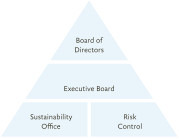
The Board of Directors
The Board of Directors (BoD) of LUKB has ultimate responsibility for the overall management, supervision and control of sustainability and sustainability risks. It sets and monitors the sustainability strategy, including the associated risks. It also monitors compliance with the relevant laws, rules and requirements that apply to sustainability topics and risks. It is responsible for external sustainability reporting and determines the general implementation framework. When exercising these duties, the BoD may call in internal and external experts to clarify matters and for further training if necessary.
Committees of the Board of Directors
The committees of the BoD support the BoD in its duties. With regard to sustainability and sustainability risks, the BoD committees have the following main duties:
Audit and Finance Committee (AFC-BoD)
- Preparing BoD resolutions and making implementation decisions
- Submitting proposals to the BoD for the implementation framework as a basis for sustainability reporting
- Conducting a critical assessment of the sustainability reporting and confirming proposals to the BoD
- Reviewing compliance with statutory and internal reporting stipulations/requirements
- Discussing the quality of the underlying reporting processes with the CEO and CFO and, if necessary, with the audit firm and the Head of Internal Audit
- Monitoring and assessing internal controls in the area of sustainability reporting
- Preparing and awarding audit mandates in relation to sustainability reporting
Risk and Strategy Committee (RSC-BoD)
- Preparing BoD resolutions and making implementation decisions
- With regard to the sustainability strategy, the Risk and Strategy Committee has the following duties:
- Preparing the basis for decision-making regarding the sustainability strategy as part of the overall strategy for the attention of the BoD
- Monitoring the implementation of the sustainability strategy
- With regard to sustainability risks including climate-related risks, the Risk and Strategy Committee has the following duties:
- Completing the preparatory tasks delegated by the BoD relating to the framework concept for institution-wide risk management (risk policy) as well as monitoring activities in the area of risk control
- Firming up risk policy requirements and adopting corresponding sub-policies
- Critically assessing the risk exposure of the parent company and the Group; monitoring the implementation of risk strategies, particularly with regard to risk tolerance and risk limits
- Monitoring and assessing the functionality and appropriateness of the internal control system (ICS), with the exception of external sustainability reporting, financial reporting and the Compliance function
- Holding periodic discussions with the CEO, the CFO, the Head of Risk Control, Internal Audit and the audit firm
The other duties of the BoD committees are described in the ‘Corporate Governance’ report in the LUKB 2025 Annual Report.
Executive Board
The LUKB Executive Board is responsible for the operational implementation of the sustainability strategy and defines the specific objectives and areas of focus for the entire Group. It is also responsible for the operational implementation of the relevant laws, rules and requirements that apply to sustainability topics and risks.
The Executive Board conducts an annual evaluation of sustainability management and sustainability risks in terms of their fitness for purpose and effectiveness, and ensures that the material and human resources needed for efficient management are in place. It discusses the internal reports on sustainability topics and makes decisions on relevant topics according to need and urgency. At Executive Board level, responsibility for sustainability lies with the CEO.
Sustainability Office
The Sustainability Office is the internal and external point of contact for questions related to sustainability and supports the dialogue with LUKB stakeholders. Working alongside the Executive Board, it prepares the Group-wide sustainability strategy. The Sustainability Office conducts regular (at least annual) reviews and assessments of material topics, targets, target achievement and the measures set out in the sustainability strategy. It also provides impetus for the ongoing development of sustainability management. and supports other LUKB organisational units across the Group as they implement sustainability measures.
Working together with the CFO and Communications, the Sustainability Office ensures that external sustainability reporting complies with the regulatory requirements and the Board of Directors' guidelines. In addition, it assists Communications with both internal and external sustainability-related communications. The Sustainability Office reports regularly to the Executive Board and Board of Directors. This includes internal reporting on sustainability to the Executive Board, the Risk and Strategy Committee of the Board of Directors (RSC-BoD) and the Board of Directors. This reporting is carried out at least once a year.
More broadly, the Sustainability Office's remit includes monitoring and analysing developments and new regulatory requirements in the area of sustainability. It supports relevant sustainability knowledge-building within the Group at all management levels, including the Board of Directors and the Executive Board (see ‘Sustainability training’ in the ‘Employer responsibility and attractiveness’ section of this Sustainability Report). The Sustainability Office also runs campaigns to raise employee awareness of sustainability issues.
Risk Control
The independent Risk Control function is responsible for monitoring the risk profile, taking into account sustainability/ESG risk factors (second line of defence). It reports quarterly in a risk report on the risk situation, compliance with risk tolerance and compliance with limits across all risk categories to the Executive Board, the Risk and Strategy Committee of the Board of Directors (RSC-BoD), and the Board of Directors. Sustainability risks, including climate risks, are not a standalone risk category, but rather a driver of default, market, liquidity, operational, compliance, strategic and reputational risks. Risk Control is also responsible for the conceptual and methodical integration of sustainability/ESG risks into the risk management framework.
Every year, Risk Control conducts a qualitative risk assessment of the impact of climate risks, including climate-related financial risks, as a driver for the risk categories of default, market, liquidity, operational, compliance, strategic and reputational risks with a first-line-of-defence expert committee. The first-line-of-defence expert committee consists of the Sustainability Office, Credit Risk Management, Finance & Investment Management Support and the Asset Management Sustainability Office. For specific portfolios with increased risk exposure to climate-related financial risks, quantitative scenario analyses are carried out periodically, where possible and appropriate.
Further information on climate risks can be found in the ‘Greenhouse gas emissions and climate protection’ section of this Sustainability Report. For information on corporate governance at LUKB, please refer to the ‘Corporate Governance’ report in the LUKB 2025 Annual Report. For information on the role and responsibilities of the Risk Control function, please refer to the ‘Financial Report’ section in the ‘Risk Management’ section of the notes to the 2025 LUKB Annual Report.
Reporting
LUKB has structured its internal and external reporting in the area of sustainability and sustainability risks as follows:
Type of reporting | Recipients | Frequency | ||
External sustainability report (including climate report) based on:
|
| Once a year | ||
Internal report from the Sustainability Office on sustainability, including implementation status of the sustainability strategy (including climate strategy and climate transition plan)1) |
| At least once a year | ||
Internal risk report of Risk Control (second line of defence) on the risk situation, compliance with risk tolerance and compliance with limits across all risk categories2) |
| Quarterly |
1)Including assessment of the effectiveness of measures as well as significant trends and developments in the area of sustainability
2)Sustainability risks, including climate-related financial risks, are not a standalone risk category, but rather a driver of default, market, liquidity, operational, compliance, strategic and reputational risks; at least once a year, the internal risk report is supplemented by an analysis of the climate-related financial risks identified for the attention of the Executive Board and the Risk and Strategy Committee of the BoD.
Memberships and initiatives
LUKB supports various initiatives and programmes relating to relevant sustainability topics and is guided by their standards, recommendations and objectives:
Association/initiative | Description | Role of LUKB | ||
|---|---|---|---|---|
UN Sustainable Development Goals (SDG) | The United Nations (UN) 2030 Agenda contains 17 goals and 169 targets for sustainable development. The SDGs factor in three dimensions: economic, social and environmental. | LUKB is guided primarily by the seven SDGs that are relevant to it. Further information on the SDGs can be found in the Annex of this Sustainability Report. | ||
UN Principles for Responsible Investment (PRI) | The Principles for Responsible Investment are an investor initiative supported by the United Nations. | LUKB voluntarily signed the UN PRI in 2019. | ||
UN PRI «Spring» | «Spring» is a stewardship initiative of the UN PRI. It addresses the systemic risks of biodiversity loss in order to protect the long-term interests of investors. The initiative aims to contribute to the global goal of halting and reversing biodiversity loss by 2030. | LUKB has been voluntarily participating in the Spring initiative since 2024. | ||
Climate Action 100+ | Climate Action 100+ is an investor-led initiative. It aims to ensure that companies, including some of the world's largest greenhouse gas emitters, take appropriate action on climate change to mitigate financial risks and safeguard the long-term value of their assets. LUKB has been a part of this influential initiative since 2021. | LUKB has been voluntarily participating in the Climate Action 100+ initiative since 2021. | ||
FAIRR | The FAIRR initiative was founded in 2015 and is an investor network that aims to raise awareness of material risks and opportunities in intensive animal agriculture and the global food sector. Together with investors, it carries out engagement activities with companies in the agriculture and food sector. | LUKB has been voluntarily participating in the FAIRR initiative since 2022. | ||
Global Reporting Initiative (GRI) | GRI is an international organisation that provides cross-industry standards for sustainability reporting. These are applied by companies and other organisations in many countries. | LUKB voluntarily published its first report in accordance with the GRI Standards for the 2024 financial year. | ||
Task Force on Climate-related Financial Disclosures (TCFD) | For several years, the TCFD was a global initiative led by the financial industry that published recommendations on the disclosure of opportunities and risks arising from climate change. In July 2023, the sponsoring organization, the Financial Stability Board (FSB), declared the TCFD's work complete. The TCFD's recommendations have been integrated into the new standards of the International Sustainability Standards Board (ISSB, Standards IFRS S1 and IFRS S2). As a result, the TCFD was dissolved in October 2023. The use of the TCFD recommendations remains voluntary, and some companies are still required to apply them. In Switzerland, the application of the TCFD recommendations enables the implementation of provisions of the Ordinance on Reporting on Climate Matters. The TCFD recommendations therefore remain authoritative for LUKB. | LUKB published its first report aligned with the TCFD recommendations for the 2024 financial year, fulfilling the requirements of the Federal Council’s Ordinance on Climate Disclosures. | ||
Partnership for Carbon Accounting Financials (PCAF) | PCAF is a global partnership of financial institutions that are jointly developing and implementing a harmonized approach to measuring and disclosing the greenhouse gas emissions associated with their loans, investments, and capital market transactions. | LUKB voluntarily joined PCAF in 2023. In its Sustainability Report 2024, LUKB published greenhouse gas emissions for the first time in accordance with the standard developed by the PCAF for calculating and disclosing ‘financed emissions’. | ||
Paris Agreement Capital Transition Assessment (PACTA) | PACTA is a climate compatibility test that is carried out in various countries. In Switzerland, it is carried out regularly under the direction of the Federal Office for the Environment (FOEN) in cooperation with the State Secretariat for International Finance (SIF). The PACTA method is used to examine the extent to which the investments and the lending portfolios of financial institutions are in line with the goals of the Paris Climate Agreement. | LUKB voluntarily participated in the PACTA climate compatibility tests for the third time in 2024. Further details can be found in the section ‘Greenhouse gas emissions and climate protection’ of this Sustainability Report. | ||
Swiss Sustainable Finance (SSF) | SSF is an association that aims to establish Switzerland as a leading centre for sustainable financial services. It advocates for the necessary framework conditions, involves stakeholders, provides information on practical approaches and scientific findings, and creates supportive tools. | LUKB has been a voluntary member since 2021 and continued to actively participate in the Regulatory Expert Group in 2025, which deals with regulatory developments in the field of sustainability in the financial industry. | ||
öbu – Swiss Business Council for Sustainable Development | öbu is an association that supports companies in integrating sustainability into their strategy. It also offers information and training on sustainability issues. öbu's work is based on the 17 Sustainable Development Goals of the United Nations. | LUKB has been a voluntary member since 2007. | ||
Central Switzerland Sustainability Network (NNZ) | NNZ is an association that aims to promote the implementation of the 17 Sustainable Development Goals of the United Nations in Central Switzerland. | LUKB voluntarily joined the NNZ charter in 2021. |
In addition to these memberships and initiatives, LUKB is an active contributor to the sustainability-related work of the Swiss Bankers Association (SBA) and the Association of Swiss Cantonal Banks (ASCB). The subsidiary LUKB Expert Fondsleitung AG is also a member of the Asset Management Association Switzerland (AMAS).