Lending business
Relevance of the topic
Lending remains LUKB's most important business area, in terms of both the financial volume and the contribution to operating income.
By granting mortgages and other loans, a bank has either a direct or an indirect impact on the environment and society. This also applies to the design of its range of financing and product offerings. For example, a bank's pricing can create incentives for owners to improve the energy efficiency and climate impact of their buildings in both construction and renovation projects.
At the same time, there is a risk that financial institutions might finance economic activities that are unsustainable. This includes lending transactions with companies that are, for example, involved in human rights abuses or that make a significant contribution to environmental pollution through their business operations.
Taking sustainability criteria into account within the lending business helps risks to be identified and managed at an early stage, thus contributing to the long-term stability of the Bank.
Principle
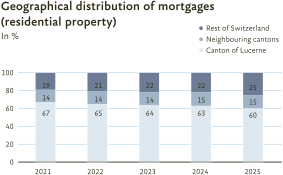
LUKB's lending business traditionally focuses on clients domiciled in Switzerland, and primarily on the Lucerne economic region. Approximately 60 % of the residential mortgage portfolio is made up by properties in the Canton of Lucerne. Transactions with borrowers situated abroad play a minor role and are limited internally as part of the risk policy. LUKB's borrowers are predominantly private individuals, small and medium-sized enterprises, large companies, collective investment entities, professional real estate firms and public-sector bodies.
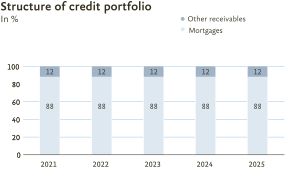
LUKB does not provide consumer credit. It mainly grants mortgage loans to private individuals. In order to ensure that mortgage loans remain sustainable even when interest rates rise, LUKB takes into account a higher imputed interest rate when granting mortgage loans – irrespective of lower market interest rates. The aim of this is to ensure that mortgage financing is sustainable in the long term, regardless of the environment and personal life situation.
LUKB ensures compliance with ethical and environmental principles when granting loans and does not finance any business that is incompatible with its sustainable focus. For LUKB, successful business operations are inextricably linked to responsibility towards the environment and society.
LUKB supports the climate policy of the Swiss federal government and the Canton of Lucerne with the aim of achieving net zero by 2050. Moreover, it has set corresponding interim targets for reducing greenhouse gas emissions by 2030 (see the ‘Greenhouse gas emissions and climate protection’ section).
By joining the Partnership for Carbon Accounting Financials (PCAF)1) in 2023, LUKB also committed to measuring and transparently disclosing indirect greenhouse gas emissions (Scope 3) in its investment and lending business.
Targets
LUKB has set itself the following targets:
- Compliance with the sustainability criteria defined by the LUKB Board of Directors for the lending business (see the explanations below)
- Compliance with the ‘Guidelines for mortgage providers on the promotion of energy efficiency'1), published by the Swiss Bankers Association (SBA). Based on these guidelines, long-term value preservation and thus also the energy efficiency of the building to be financed should be addressed within the context of lending advice for owner-occupied buildings, especially in relation to older properties or buildings in need of renovation. Renovation topics should be proactively addressed and possible measures discussed.
- Reduction of CO2 emissions from own home, residential and commercial mortgages by at least 40 % per square metre of energy reference area compared to 2023 by 2030
Status in 2025
Sustainability criteria in the lending business
Since 1 January 2025, all new on-balance-sheet and off-balance-sheet lending transactions have been subject to the following sustainability criteria, which were adopted by the LUKB Board of Directors in 2024. New loan transactions also include the roll-over and extension of existing expiring loan positions expiring at the contractual term, where the loan amount is increased and/or the existing repayment arrangements are reduced.
Within the framework of the general exclusion criteria, the following lending transactions are generally excluded for all borrowers at LUKB (no thresholds applied):
- Lending transactions involving the acceptance of illegal (ground) water pollution
- Lending transactions with persons and companies that adversely affect protected areas or areas with a high conservation value in Switzerland and abroad (e.g. virgin forests, endangered animal and plant species, wetlands, biotopes, cultural assets and world heritage sites)
- Lending transactions with persons and companies whose (business) activities violate relevant human rights and labour rights, specifically the international conventions on human rights and labour rights that have been ratified by Switzerland as well as other relevant Swiss law in this area
- Lending transactions with persons and companies that violate the rights of indigenous peoples or that are involved in serious instances of corruption
In addition, LUKB has defined the following specific exclusions, which also apply to all borrowers in general (no thresholds applied):
- Financing the mining/extraction of fossil fuels (oil, natural gas, coal). This also includes controversial processes for extracting oil and natural gas such as Antarctic/Arctic drilling, fracking, offshore oil projects, deepwater drilling and projects related to the exploitation of oil from tar sands.
- Financing projects for the construction of new fossil and nuclear power plants
- Financing uranium mining and other mining projects abroad
- Financing agriculture, forestry and fishing abroad; the exclusion covers in particular the financing of non-certified agriculture and forestry (e.g. no FSC or equivalent certificates available) and non-certified fishing (e.g. no MSC or equivalent certificates available). Financing of the production of non-certified palm oil is also excluded.
- Financing the development, manufacture and distribution (sale and trade) of problematic pesticides (e.g. neonicotinoids and organic chlorine compounds)
- Financing the release of genetically modified organisms (GMOs)
- Financing transactions related to the sale of and trade in critical products, including thermal coal, crude and heavy fuel oil, asbestos, uranium, non-certified precious woods, conflict diamonds and non-certified palm oil
- Financing the development, production, stockpiling and/or distribution of controversial weapons. Controversial weapons include, among others, cluster bombs, cluster munitions, anti-personnel and landmines, biological and chemical weapons, nuclear weapons, enriched uranium, blinding laser weapons and incendiary weapons.
- Financing gambling for which no licence has been granted by the Federal Gaming Board (FGB)1)
- Financing persons and companies whose business activities involve the production of pornographic material or prostitution
In addition, exclusions relating to controversial business practices and high environmental, social and governance (ESG) risks have been in place for capital market-oriented borrowers since 1 January 2025. The assessment of controversial business practices is based on the following standards and conventions:
- Guidelines on the organisation for economic co-operation and development (OECD) for multinational enterprises, i.e. the OECD Guidelines for Multinational Enterprises
- Ten Principles of the United Nations Global Compact (UNGC)
- United Nations Guiding Principles on Business and Human Rights (UNGP)
- Fundamental conventions of the International Labour Organization (ILO) and the ILO Declaration on Fundamental Principles and Rights at Work
The risk sub-policy for non-banks adopted each year by the Board of Directors' Risk Committee lists, among other things, the ‘sustainability of the business model’ as a criterion for assessing the creditworthiness of the Bank's clients within the section on ‘basic principles’. If creditworthiness is deemed unsatisfactory, LUKB refuses lending.
Loans for the extraction of coal, oil and gas
As in the previous year, there were no lending transactions for the direct financing of coal, oil or gas extraction throughout the entire 2025 financial year. This also applies to lending transactions for the direct financing of activities in the field of unconventional oil and gas extraction, such as oil sands, shale oil and gas, Arctic oil and gas, liquefied natural gas (LNG) or ultra-deepwater (UDW) oil and gas extraction.
Promoting energy efficiency within mortgages
LUKB has incorporated the ‘Guidelines for mortgage providers on the promotion of energy efficiency’ published by the Swiss Bankers Association (SBA) into the advisory process for the financing of owner-occupied homes. These guidelines require the long-term value preservation and thus also the energy efficiency of the building to be financed to be addressed within the ambit of real estate financing advice. This applies in particular to older properties or those in need of renovation. Corresponding renovation topics should be addressed and renovation measures discussed.
To implement this, LUKB ensures that its advisors receive regular and appropriate training, both in terms of how to maintain the value and improve the energy efficiency of properties over the long term and how to finance corresponding measures.
Advisors systematically address sustainability-related issues with their clients during advisory sessions, focusing on the life cycle of the property in question. A renovation cost and carbon calculator supports the visualisation of costs and the carbon footprint for key topics that help to reduce CO2 emissions, such as replacing the heating system, upgrading the building envelope and installing solar panels. This calculator has been available to LUKB clients free of charge within e-banking since 2021.
Where the client wishes to invest in improving energy efficiency, advisors point out possible subsidies and, if necessary, provide detailed checklists for the renovation of single-family homes, condominiums and multiple-family properties.
Energy-saving mortgage plus
With the ‘energy-saving mortgage plus’, LUKB offers low-interest mortgages for owner-occupied homes and multiple-family properties to finance the following investments:
- Energy-related renovations of existing properties, where energy-related measures must account for at least 60 % of the total renovation costs
- Solar and photovoltaic systems for own consumption, battery storage and electric charging stations
- Construction of new buildings requiring a building energy certificate (GEAK A/A/A), a Minergie certificate or an SNBS certificate (Standard Nachhaltiges Bauen Schweiz)
With this product, LUKB also provides easy access to its network of qualified, independent energy experts. These experts are on hand to provide their expertise, advice and support to clients in order to increase the energy efficiency of buildings and thus reduce CO2 emissions.
For further information, please visit https://www.lukb.ch/energiespar-hypothek (in German)
Lending volume
The volume of credit products for the financing of environmentally sustainable construction measures has developed as follows:
Unit | 2020 | 2021 | 2022 | 2023 | 2024 | 2025 | ||||||||
Credit products | ||||||||||||||
Energy-saving mortgages plus1) | CHF millions | n. a. | n. a. | n. a. | 1.5 | 18.4 | 33.5 | |||||||
Energy-saving mortgages | CHF millions | 2.6 | 7.6 | 14.1 | 19.0 | 18.4 | 15.0 | |||||||
Renovation mortgages2) | CHF millions | 16.1 | 12.0 | 8.9 | 5.8 | 4.5 | 3.1 | |||||||
Minergie mortgages2) | CHF millions | 182.2 | 145.8 | 107.8 | 76.7 | 49.8 | 27.0 |
Volumes as of the reporting date 31 December
1)The ‘Energy-saving mortgage plus’ (‘Energiespar-Hypothek plus’ in German) product was launched in October 2023 and replaced the previous energy-saving mortgage.
2)These products have been discontinued since 31 July 2020.
‘myky’ sustainable own home
Together with 18 other cantonal banks, LUKB holds an indirect stake in the ‘myky’ platform. The platform aims to further establish sustainability for owner-occupied buildings. ‘myky’ is a one-stop shop offering comprehensive services and expertise in relation to all aspects of home ownership.
Further information: https://www.myky.ch (in German)
Services for real estate investors and corporate clients
In addition to financing solutions, LUKB offers real estate investors and corporate clients comprehensive and tailored real estate expertise over the entire life cycle of a property. LUKB's real estate experts provide clients with comprehensive support, from analysis and strategy to planning, implementation and financing. The consideration of ecology and sustainability is always a key part of this.
Further information: https://www.lukb.ch/unternehmen/immobilien (in German)
Reference guides and information for the general public and businesses
LUKB has extensive market knowledge and expertise as the leading provider of real estate financing and services in the Lucerne economic region. It makes this knowledge available to the public via free reference guides and newsletters on its website. Furthermore, LUKB regularly publishes a comprehensive report on the Lucerne real estate market with market figures, expert assessments, current developments, trends and challenges – including issues such as the shortage of housing supply.
Further information: https://www.lukb.ch/private/immobilienfinanzierung/hilfsmittel/luzerner-immobilienmarkt (in German)
In addition, LUKB regularly holds events such as specialist lectures and information events for the general public and the business community, and attends relevant trade fairs.
Data management
Since 2022, LUKB has been working to align the collection, management and analysis of data in relation to the financed building portfolio with the new requirements resulting from the enhanced reporting requirements in the areas of energy efficiency and climate protection. In recent years, the focus has been on integrating Federal Building Identifiers (EGID) into the Avaloq core banking system. As a result, LUKB has laid the foundations for supplementing building data in its lending portfolio with additional information in order to calculate energy efficiency and carbon emissions.
LUKB has also integrated data from the Federal Register of Buildings and Dwellings (RBDO) into its core banking system and advisory solution. This enables various aspects of buildings (e.g. heating information) to be taken into account when advising and informing clients. The data is updated twice a year.
Energy efficiency of the financed buildings
All buildings financed by LUKB receive an energy efficiency rating from A to G (A = best energy efficiency). The classification is based on the cantonal building energy certificate (GEAK). LUKB works with a Swiss data service provider specialising in real estate for the calculations and classifications.
The results of the sub-portfolios are presented as follows:
31.12.2024 | 31.12.2025 | Change from the previous year | ||||||||
Single-family homes | Number of buildings | Percentage of buildings | Number of buildings | Percentage of buildings | Number of buildings | |||||
Good energy efficiency1) | 3,456 | 22 % | 3,582 | 22 % | 126 | |||||
Average energy efficiency2) | 5,143 | 31 % | 5,252 | 31 % | 109 | |||||
Poor energy efficiency3) | 7,768 | 47 % | 7,904 | 47 % | 136 | |||||
Total | 16,367 | 100 % | 16,738 | 100 % | 371 |
1)Rating classes A to C (0 to 120 kWh per m2 energy reference area, ERA)
2)Rating classes D and E (121 kWh to 200 kWh per m2 ERA)
3)Rating classes F and G (> 200 kWh per m2 ERA)
31.12.2024 | 31.12.2025 | Change from the previous year | ||||||||
Condominiums | Number of buildings | Percentage of buildings | Number of buildings | Percentage of buildings | Number of buildings | |||||
Good energy efficiency | 12,535 | 72 % | 12,655 | 70 % | 120 | |||||
Average energy efficiency | 4,304 | 24 % | 4,659 | 26 % | 355 | |||||
Poor energy efficiency | 745 | 4 % | 823 | 4 % | 78 | |||||
Total | 17,584 | 100 % | 18,137 | 100 % | 553 |
The same definitions apply to energy efficiency classes as for single-family homes (see table above).
Around 70 % of the condominiums are highly energy-efficient – a result that can also be attributed to the development history of condominiums. However, there is still a high need for investment in the case of single-family homes – almost 50 % have a poor energy efficiency rating.
31.12.2024 | 31.12.2025 | Change from the previous year | ||||||||
Multiple-family properties | Number of buildings | Percentage of buildings | Number of buildings | Percentage of buildings | Number of buildings | |||||
Good energy efficiency | 1,408 | 20 % | 1,558 | 21 % | 150 | |||||
Average energy efficiency | 3,302 | 46 % | 3,336 | 46 % | 34 | |||||
Poor energy efficiency | 2,392 | 34 % | 2,447 | 33 % | 55 | |||||
Total | 7,102 | 100 % | 7,341 | 100 % | 239 |
The same definitions apply to energy efficiency classes as for single-family homes (see table above).
Around two-thirds of apartment buildings have a good or average energy efficiency rating. On average, buildings in rural areas perform worse than those in urban areas.
31.12.2024 | 31.12.2025 | Change from the previous year | ||||||||
Other buildings | Number of buildings | Percentage of buildings | Number of buildings | Percentage of buildings | Number of buildings | |||||
Good energy efficiency | 1,022 | 51 % | 1,007 | 50 % | – 15 | |||||
Average energy efficiency | 783 | 38 % | 783 | 39 % | 0 | |||||
Poor energy efficiency | 232 | 11 % | 237 | 11 % | 5 | |||||
Total | 2,037 | 100 % | 2,027 | 100 % | – 10 |
The same definitions apply to energy efficiency classes as for single-family homes (see table above).
Commercial properties such as hotels, industrial and commercial buildings, and business properties achieve better energy efficiency values on average than residential properties. Here, too, the pattern is similar to that of apartment buildings. In urban areas, buildings tend to perform better than in rural areas.
Greenhouse gas emissions and climate protection
Further information on financed greenhouse gas emissions for residential and commercial buildings as well as corporate loans and the reduction targets for the mortgage portfolio are disclosed in the ‘Greenhouse gas emissions and climate protection’ section.
COVID-19 loans
Following the outbreak of the COVID-19 pandemic, LUKB quickly stepped up to the mark. As part of the federal government's COVID-19 loan programme, LUKB disbursed more than 1,700 loans worth a total of 250 million Swiss francs within just a few days in the spring of 2020. In addition, LUKB offered further liquidity assistance to SME clients on its own initiative, over and above the provision of federal government loans, and provided additional relief quickly by suspending contractual repayment schedules.
At the end of 2025, following repayments totalling 18.9 million Swiss francs during the 2025 financial year, LUKB still had 607 COVID-19 loans outstanding for a total of 26.2 million Swiss francs (end of 2024: 718 COVID-19 loans totalling 45.1 million Swiss francs). In the previous year, redemptions amounted to 25.2 million Swiss francs.