Employer responsibility and attractiveness
Relevance of the topic
Employees are a key success factor at LUKB. As a service provider, the quality of the services offered depends directly on the commitment, competence and motivation of its employees. A high level of attractiveness as an employer and targeted vocational education and training are therefore key levers for sustainable value creation.
In an increasingly competitive employment market, LUKB's strong position as an employer enables it to attract, develop and retain qualified specialists over the long term. This makes a significant contribution to the stability of the organisation, its ability to provide high-quality services as well as its innovative capacity and future viability. At the same time, LUKB's stakeholders expect responsible and forward-looking HR management. Consciously assuming social responsibility as an employer thus forms a key basis for sustainable corporate success and long-term competitiveness.
Principle
A positive and productive corporate culture is key to employee retention. Flexible working models, regular employee surveys, talent development programmes and targeted and generous investments in further education and training create an environment in which everyone feels valued and inspired. The promotion of young talent is especially important to LUKB: With its StartUp@LUKB programme, it gives young talents the opportunity to enter the world of banking.
Human Resources at LUKB's shapes and implements elements of HR strategy, drives organisational efficiency and promotes employee development. The aim is to have an agile, diversified and high-performing workforce that actively supports the corporate strategy.
Human Resources plays a key role in attracting, developing and retaining talent. LUKB uses employee initiatives and further education programme to enhance employee capabilities, enabling the bank to successfully face up to the challenges that arise in a changing business climate. The focus is on recruiting specialists and encouraging an inclusive culture that embraces diversity and collaboration.
In addition, HR sees itself as a strategic partner that actively supports the corporate vision and contributes to long-term competitiveness and sustainable growth. In an environment full of innovation and change, LUKB makes every effort to cater flexibly and proactively to both the needs of its employees and the demands of the market.
Targets
LUKB aims to remain one of the top employers in Central Switzerland. Target achievement is measured annually by surveying all employees on the aspects of ‘commitment’ and ‘satisfaction’. The aim is to score at least 80 points on a scale of 1 to 100 for both aspects.
LUKB takes part in the Swiss Arbeitgeber Award (Swiss Employer Award) every three years. This survey covers additional aspects such as ‘attractive employer’ and ‘would recommend as an employer’. LUKB aims to be in the top third of companies with more than 1,000 employees.
Status in 2025
Further increase in headcount
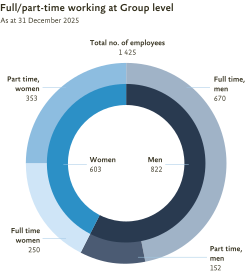
LUKB further increased its headcount in the year under review and, at the end of 2025, employed a total of 1,425 people at Group level (end of 2024: 1,385 people), with a total of 1,206.2 full-time equivalents (end of 2024: 1,181.0). Full-time equivalents are adjusted for part-time positions and trainees are weighted at 50 %.
As at 31 December 2025, the workforce of the entire LUKB Group was made up of a total of 603 women (end of 2024: 593) and 822 men (end of 2024: 792). At the end of 2025, 353 women and 152 men were working part time (end of 2024: 333 women and 147 men).
This makes LUKB one of the biggest employers in the Canton of Lucerne.
Low staff turnover
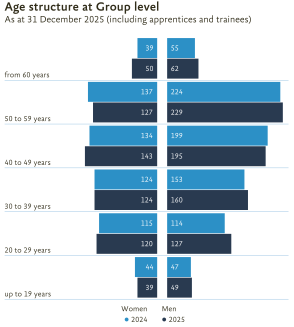
The net staff turnover rate (i.e. without taking into account retirements or departures for family reasons such as pregnancy and death) was 4.3 % in 2025, compared with 3.2 %). LUKB strives to ensure a balanced distribution of ages and genders within a team when recruiting.
High ethical standards in human resources policy
LUKB is committed to high ethical standards in its HR policy. It is actively committed to equal opportunities, non-discrimination and inclusion – regardless of gender, gender identity, age, marital status, religion, nationality, ethnic origin, skin colour, social background, physical limitations, sexual orientation or political beliefs. LUKB consciously promotes diversity, as it recognises the value of having employees with different backgrounds when it comes to challenging tasks. LUKB also has a zero-tolerance policy on inappropriate behaviour, workplace bullying and sexual harassment. Internal and external points of contact are available to those affected (see ‘Critical concerns’ in the ‘Business ethics and compliance’ section).
Employee surveys
Every three years, LUKB takes part in the comprehensive employee survey conducted by the Swiss Arbeitgeber Award. The last survey was held in summer 2024. LUKB came second out of all companies with more than 1,000 employees. LUKB's results are consistently high in all of the relevant criteria (commitment, satisfaction, no resignation, attractive employer, would recommend employer). The response rate was 82 %.
In the intervening years, LUKB conducts a reduced Group-wide survey, most recently in November/December 2025. With a response rate of 89 %, the survey reached a new high in terms of participation. It provides a solid basis for substantiated information on employer attractiveness and corporate culture. The results show that LUKB also offers a stable and motivating working environment in the long term. The scores achieved in the key aspects of commitment, satisfaction and lack of resignation were even higher than in the previous year. These record figures illustrate the employees' high level of identification with LUKB and their long-term loyalty to the company. The results collected for the first time on team and leadership quality are slightly more critical than in the previous year, but are within the usual fluctuations in comparable surveys. They provide valuable impetus for the continuing development of leadership, collaboration and organisational resilience.
Unit | 2021: Swiss Employer Award survey | 2022: Reduced internal survey at Group level | 2023: Reduced internal survey at Group level | 2024: Swiss Employer Award survey | 2025: Reduced internal survey at Group level | |||||||
Survey participation | % | 87 % | 86 % | 81 % | 82 % | 89 % | ||||||
Commitment | Value1) | 84 | 85 | 86 | 84 | 86 | ||||||
Satisfaction | Value1) | 76 | 76 | 79 | 78 | 79 | ||||||
Attractive employer | Value1) | 81 | n. a. | n. a. | 82 | n. a. | ||||||
Would recommend employer | Value1) | 92 | n. a. | n. a. | 93 | n. a. |
1)Scale from 1 to 100 (100 = best)
The results of the employee surveys are systematically evaluated and discussed at an Executive Board and division level. This results in prioritised fields of action. In areas or teams with more critical results, specific in-depth discussions are held in a targeted manner. As required, the support of HR is called in to develop suitable measures to improve management quality, team collaboration and work organisation.
Typical measures include, but are not limited to:
- Targeted management dialogue and structured feedback formats
- Individual or team-related development and coaching offerings
- Adjustments to processes, role clarification or internal communication
- Raising managers' awareness of motivation, psychological safety and sustainable performance
The defined measures will be implemented step by step and incorporated into existing management and HR governance. Responsibility for implementation lies with the respective managers, supported by HR. Progress is regularly reviewed by HR and is included in future surveys. In this way, LUKB ensures that the findings from the surveys are consistently translated into concrete improvements and continuously developed.
The majority of LUKB employees are voluntary members of the internal employee organisation, the ‘Personalverein’, and are thus able to raise their concerns directly. The Head of Human Resources engages in regular dialogue with the Personalverein to ensure that concerns are identified at an early stage and pragmatic solutions are found.
Attracting and retaining employees
One of the deciding factors in the success of any company is its ability to identify, recruit, develop and retain qualified employees. This factor has become all the more important in view of the shortage of specialist personnel. LUKB also took a close look at innovative talent management strategies during 2025 with the aim of attracting and retaining staff.
LUKB pursues a sustainable and equal-opportunity recruitment strategy that targets different demographic groups and promotes equal access to the employment market.
- Trainee programmes for university graduates: LUKB offers a structured introductory programme that is actively promoted at university fairs. It enables transparent, performance-based career entry in various specialist fields and supports the long-term development of young talents.
- Internships for students and graduates: Various internship formats provide practical insights into LUKB, facilitate the transition from education to the professional world and promote equal opportunities when starting a career.
- Vocational training: LUKB is committed to promoting the next generation of professionals through practical training programmes and entry-level formats that enable young people, regardless of their educational background, to enter the world of work.
- Returning to work after interruption: Returning to work after parental leave, unemployment or for other reasons is taken care of through regular recruitment and onboarding processes. In doing so, individual life situations are taken into account and equal opportunities are ensured in the application process.
Altogether, these measures make an important contribution to social sustainability, the promotion of diversity and the long-term retention of specialist and junior employees.
Talent management
In 2025, LUKB introduced the structured talent and succession process across the Group, which had been successfully tried and tested in the previous year. This process systematically identifies strategically relevant key positions and develops internal talents at an early stage. For example, long-term HR and succession planning is firmly enshrined in management and HR governance.
The process secures critical expertise, strengthens organisational competencies and reduces risks in key positions. At the same time, it promotes internal mobility, targeted development and the long-term retention of employees. The transparent and standardised approach ensures fair, objective talent identification and supports diversity and equal opportunities.
Through the continuous development of managers and key individuals, LUKB strengthens its organisational resilience and innovative strength. With the successful roll-out, LUKB is consistently pursuing the objectives defined in the previous year and ensuring the effectiveness of the process through regular reviews and further development.
Empowering and developing leaders
Continually empowering and developing leaders is a particular priority for LUKB. It firmly believes that well-trained and inspiring managers make a key contribution to business performance. Its investment in leadership development is designed to promote a culture of innovation, engagement and efficiency. To achieve this, LUKB has launched specific programmes to continually improve leadership skills and promote personal responsibility and self-management. By offering a wide range of courses, LUKB ensures that both inexperienced and experienced managers are able to acquire the necessary skills to effectively fulfil their role. This is achieved through the following programmes:
- ‘Welcome to LUKB for managers’: A one-day onboarding session for new managers and those with no previous management experience. The focus is on LUKB's understanding of leadership and processes throughout the employee life cycle.
- ‘Leadership basics’: A mandatory six-month learning journey for all new managers. The aim is to impart fundamental leadership knowledge and promote networking among managers within LUKB.
- Mandatory leadership training: One-day training sessions for all managers to expand their knowledge of specific topics.
- ‘Leadership intensive programme’: A programme designed by LUKB for managers with high potential. Study under this scheme earns ECTS points at the Lucerne University of Applied Sciences and Arts (HSLU).
- Senior management training: Regular workshops on various leadership topics for senior managers.
The emphasis here is on practical training that draws on both established management principles and current sector trends. This not only ensures a internal employee development over the long term, but also encourages its management to identify with LUKB's corporate objectives.
Diversity, equity and inclusion (DEI) are an integral part of management development at LUKB. In development and professional training programmes, managers are made aware of their role in promoting equal opportunities, diversity and a respectful working environment in a targeted manner. In particular, the importance of fair decision-making processes, inclusive collaboration and appreciative leadership is addressed. By embedding DEI aspects in management development, LUKB ensures that these principles are put into practice sustainably in day-to-day management activities and contribute to an open, efficient and forward-looking corporate culture.
Employee development
LUKB attaches great importance to developing its employees and therefore offers a wide and comprehensive range of over 150 internal further education and training courses in the areas of specialist training, interdisciplinary skills, sales excellence and occupational health management. These training programmes focus on providing holistic and balanced advice to clients in all situations. Employees also attend practical workshops and take part in specialised basic and advanced training modules on financial products and services. The aim is to prepare employees for future professional challenges and to further develop their skills. Well-trained employees are key to the future of LUKB. LUKB also works with various external partners and educational institutions, such as the Bankenberatungszentrum (bbz), the Lucerne University of Applied Sciences and Arts (HSLU) and the University of Lucerne.
The performance and development dialogue framework, known by its German acronym LED, is an important tool for managers. In continuous dialogue, employee performance is assessed based on several criteria, while binding targets are also set and their progress in achieving these documented. Development measures are also agreed at least once a year and employees have the opportunity to provide feedback to their line managers in a full 360° approach. The process, which is managed by Human Resources, is used for all employees at all functional levels.
Investment in further education and training
LUKB is one of the largest employers in the Lucerne economic area and takes its responsibility as a training institution seriously. In 2025, employees invested a total of 14,261 working days in further education and training (previous year: 13,172), which equates to 11.8 days (previous year: 11.2) per full-time equivalent. In contrast to the previous year's report, these figures for both years also include the further education days of commercial apprentices without a Federal Vocational Baccalaureate. In total, as in the previous year, investment in further education and training measures (excluding internal costs) amounted to around 1,800 Swiss francs per full-time position. LUKB aims to strengthen the technical, managerial and social skills of its employees at all age and function levels through further education and training.
Around 90 vocational training positions
In 2025, LUKB employed 19 apprentices in business-related positions (previous year: 17 apprentices), 2 apprentices in IT (previous year: 2), one apprentice in the catering sector (previous year: 0), 10 interns under the ‘Bankeneinstieg für Mittelschulabsolventen’ (BEM) introductory banking programme for secondary school leavers (previous year: 9) and 1 intern from an IT secondary school (previous year: 2). Their courses will start in August 2026.
The intention is to continue employing as many apprentices and interns as possible after they have completed their training, and to help them develop with targeted training programmes, both internally and externally. LUKB has been running the ‘StartUp@LUKB’ programme since 2021 with the aim of attracting highly qualified talent to LUKB and preparing them specifically for future key roles. This strategically important development programme is aimed at university graduates and qualified people who are changing career paths, offering them a structured range of further training and continuing education opportunities. LUKB is thus not only creating attractive development prospects, but it is also strengthening its competency base and innovative strength in the long term. At the end of 2025, a total of 15 people received training as part of this programme (end of 2024: 16). LUKB offered a total of 87 training positions at the end of 2025 (end of 2024: 87).
Sustainability training
In the 2025 financial year, LUKB once again held information events, training courses and workshops on sustainability at the various management levels.
All new LUKB employees have to complete web-based basic training on ESG and sustainability during their induction.
Client advisors and assistants in the ‘Private & Commercial Clients’ and ‘Corporate Clients & Private Banking’ departments receive needs-based training on the following topics, among others:
Sustainable investing
- Basics and in-depth analysis of sustainability and ESG
- Sustainable investing in practice: approaches, criteria, ratings and products
- Regulatory requirements, including the relevant SBA guidelines and AMAS self-regulation
- ESG preferences and risks in investment advisory and asset management
- LUKB's investment-related dialogue and engagement activities
- ESG reporting and fact sheets for investment clients
Sustainable lending
- Basics and in-depth analysis of sustainability and ESG
- Principles of sustainable construction, remodelling and renovation
- Statutory and regulatory requirements and developments
- Sustainability topics in the advisory process and the corresponding adjustments to the advisory cockpit
- Renovation cost and carbon calculator
- Financing options and the ‘Energiespar-Hypothek plus’ energy-saving credit product
- Public- and private-sector support schemes
- Engagement of independent certified energy experts
LUKB introduced new online courses in 2025 to provide further practical basic knowledge of sustainability in the real estate sector. These were developed by a service company specialising in real estate and are mandatory for all client advisors who handle own-home financing.
In 2025, LUKB once again conducted advanced training courses on ecology and sustainability in the real estate sector for client advisors and assistants. Environmental and social aspects in the construction and real estate sectors were examined using concrete practical examples.
The SAQ ‘Private Clients’, ‘Individual Clients’, ‘Affluent Clients’ and ‘Private Banking’ certification programmes similarly include training on sustainability and ESG. More than 95 % of all client advisors at LUKB are currently SAQ-certified.
The topics of ecology and sustainability are also an integral part of the training courses for the Bank's apprentices.
Training in responsible advisory and sales practices
Through their advisory and sales practices, banks directly influence how transparent and factual the information their clients receive is, and how they access suitable products and services. LUKB therefore attaches great importance to training its client advisors in responsible advisory and sales practices.
Through targeted training programmes, LUKB imparts ethical standards, sustainable values, legal and regulatory requirements (e.g. the provisions of the Financial Services Act [FinSA] on obligations of conduct, due diligence and transparency) and other necessary expertise. The training covers the entire advisory process, including the analysis of client needs, the individual products and services as well as effective communication and conversation techniques.
LUKB employees must attend mandatory compliance training on a regular basis. This covers issues such as combating money laundering and the financing of terrorism, compliance with market behaviour rules and measures to combat corruption and protect personal data. As part of their induction, new employees are required to attend relevant training courses that are specific to their role or business area. Further information on compliance training can be found in the ‘Business ethics and compliance’ and ‘Digitalisation, information security, data protection and privacy’ sections of this report.
In addition, advisors attend further training and awareness-raising sessions on various sustainability topics (see the ‘Sustainability training‘) section above.
With the aim of ensuring the quality, advisory philosophy, advisory experience and efficiency of each individual advisory service, LUKB has developed a digitally managed advisory process that supports client advisors in their preparation and follow-up work. The advisory process was developed with the involvement of clients and rolled out in all sales segments in spring 2023. Client advisors benefit from clear structures and reliable guidance. The digitally managed advisory process also helps to ensure that training course content is implemented in a standardised manner. This helps to ensure high-quality advice while strengthening client trust.
For further information, please refer to ‘Responsible marketing and sales practices’ in the ‘Business ethics and compliance’ section.
Occupational health and safety
LUKB pursues strategically enshrined occupational health management (OHM) with the following objectives:
- Sustained improvement of employees' physical and mental health
- Early identification and minimisation of work-related health risks
- Avoidance of occupational accidents
This is based on a holistic OHM concept that includes preventive measures, health promotion, awareness-raising and case management.
LUKB's OHM covers all employees at all Group locations and is based on the recognised guidelines of the Swiss National Accident Insurance Fund (SUVA), the Swiss Council for Accident Prevention (BFU) and the Federal Coordination Commission for Occupational Safety (FCOS).
OHM at LUKB is clearly organised and enshrined in the existing management and governance structures. Overall responsibility lies with the Executive Board, supported by the responsible specialist units. Managers have a central responsibility for implementing health and safety requirements in their day-to-day work.
Work-related risks and hazards are regularly identified and assessed, taking into account physical, ergonomic and psychological stress, including through risk analyses, employee surveys and the evaluation of relevant health and absence indicators. Preventive measures are developed and implemented on this basis.
Through targeted training and offerings on resilience, exercise, nutrition and ergonomics, LUKB helps to improve individual health literacy, achieve long-term performance and reduce absences.
LUKB is actively committed to reducing the stigma associated with mental health. This is achieved, among other things, through awareness-raising measures, training for managers (courses from the ‘ensa’1 programme) and an open culture of communication that promotes the responsible handling of psychological stress.
Employees are provided with support services to assist them in the event of psychological stress or challenging life situations. These services are confidential and are part of LUKB's holistic approach to healthcare.
The establishment and further development of relevant KPIs make it possible to monitor the effectiveness of the measures, track progress transparently and continuously develop OHM in an impact-oriented manner.
Defined reporting and investigation processes are in place for work-related accidents, health impairments and safety-related incidents. These enable a systematic investigation of the causes and the development of suitable preventive and improvement measures.
Health and safety topics are taken into account as part of internal controls and regular reviews. LUKB ensures that legal requirements are complied with and, if necessary, reviews its processes as part of internal audits.
LUKB line managers should create a culture of appreciation, open communication and support with the aim of promoting employee well-being and preventing psychosocial stress such as bullying and conflicts. Their ability to act as role models is crucial in this regard: they should exemplify healthy behaviour and thus send a strong message to their teams.
A healthy working environment ultimately starts with management: All LUKB line managers are systematically made aware of and trained in mental health, resilience and energy management in special management seminars. Processes such as ‘absence management’ support this. Employees who are absent for more than 30 days receive individual care and support as part of case management. LUKB works with external partners to find the best possible solutions and promote reintegration. Individual measures are planned and implemented in close coordination with Human Resources. If there are any problems, employees can contact their responsible HR Business Partner or external experts for a confidential discussion.
LUKB focuses on two key approaches to prevention:
- Awareness campaigns: In 2025, the focus was on mental health. Monthly videos made by employees for employees raised awareness of the topic via the Intranet. There is also a focus on ergonomic workstations, both in the office and when working from home.
- Internal courses and initiatives: LUKB offers courses on resilience and stress management, and supports campaigns that promote healthy behaviour such as ‘bike to work’. Employees and retirees can join the sport and leisure organisation ‘Sport und Freizeit’, which promotes sporting activities and camaraderie. At the end of 2025, the association had 725 members.
The quality of OHM measures is reviewed at different levels:
- Assessment of the quality of the management seminars and OHM courses by participants
- Monitoring of early detection in the organisational units by the responsible HR Business Partners
- In case management, success is measured by reintegration. The low single-digit number of cases in case management allows LUKB to assess the quality of the measures for each individual case.
Employees who come into contact with clients are regularly trained in workplace security and what to do in the event of security threats (e.g. robberies). Regular drills are also held with the LUKB crisis team and evacuation drills are conducted at all locations. All employees are regularly informed about security issues via the intranet.
Regular security training is intended to make all employees aware of the correct behaviour in the event of incidents and to refresh their knowledge of security processes. The security measures are set out in policies and are regularly reviewed by Risk Control. Mandatory training sessions are held for all employees. Security officers support security management at all locations. All information on occupational health and safety is also available on the intranet.
The principles of health and safety also apply to external employees and service providers. When working with them, care is taken to ensure that LUKB's requirements are complied with and that a safe working environment is guaranteed.
Working time and holiday regulations
LUKB has clearly defined and binding working time models with a contractually stipulated working week of 42 hours. The aim of working time regulations is to ensure a sustainable workload, avoid overwork and protect the long-term health and performance of employees.
Compliance with working hours is the responsibility of managers and is supported by systems for the transparent recording of working hours. These allow for continuous monitoring of effective working hours and serve to identify overtime and structural workload peaks at an early stage. The majority of employees record their working hours.
Overtime is systematically recorded and evaluated. The focus is on preventive measures to reduce overtime as well as on prompt compensation. In the event of recurring or above-average overtime, managers are obliged to review and implement suitable organisational, procedural or personnel measures together with HR. In doing so, LUKB ensures that working time regulations are not only formally adhered to, but also actively contribute to promoting well-being, a good work-life balance and sustainable work performance.
LUKB's holiday entitlement is clearly defined and provides targeted support for employees' recovery, health and long-term performance. All employees have access to a contractually agreed annual holiday budget, the use of which is actively promoted and systematically monitored.
Managers regularly review holiday entitlement to ensure that holidays are actually taken and are not permanently postponed. Unused leave is subject to clear regulations. Through this control system, LUKB prevents overworking and promotes a good work-life balance.
Balancing family and career
LUKB has been pursuing a ‘family and career at LUKB' policy since 2013: in doing so, it aims to create working conditions that enable employees with family commitments to achieve a good work-life balance. The new working and working hours models that LUKB introduced in January 2022 represent the next step in this approach. They include individual solutions such as job sharing, working from home, the ability to purchase additional days of leave, sabbaticals, working part-time even in management positions and the opportunity to work full-time over 4.5 days instead of 5. These solutions are developed in close consultation with employees.
At LUKB, both women and men receive two weeks more maternity or paternity leave than is required by law (women: 16 weeks instead of 14 weeks; men: 4 weeks instead of 2 weeks). LUKB also supports families financially with a voluntary additional child allowance. In 2025, it invested a total of 1,205,940 Swiss francs (previous year: 1,152,315 Swiss francs) in this allowance.
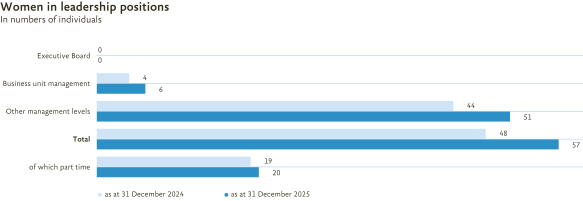
As part of its management development efforts, LUKB aims to sustainably increase the proportion of women in management positions. In this respect, LUKB adopts an equitable, performance- and potential-oriented approach that systematically integrates diversity, equality and fairness into all management, talent and succession processes. However, it does not apply rigid gender quotas at all operational management levels. On the other hand, a gender benchmark of 20 % applies at the Executive Board level (see LUKB 2025 Ownership Strategy of the Canton of Lucerne1)). In accordance with this requirement, LUKB must provide justification if each gender does not have at least 20 % representation on the Executive Board.
At LUKB, equal development and career opportunities are ensured through transparent recruitment, talent and succession processes as well as through targeted development and promotion measures that are open to all employees regardless of gender or personal characteristics and are established as an integral part of HR management. When filling management positions, qualifications, performance and development potential are assessed on the basis of clearly defined and objective criteria. At the same time, it is ensured that all candidates have equal access to development and career steps.
Equal career opportunities are also supported by standardised selection procedures, clearly defined role and requirement profiles and by making managers aware of unconscious biases. These principles also explicitly apply to employees with disabilities, ethnic minorities and different demographic groups. LUKB thus promotes an inclusive corporate culture in which diversity is seen as a strength and individual potential is developed in a targeted manner regardless of personal characteristics.
Equal pay
At LUKB, fair and progressive working conditions form the basis for a successful employment relationship. This includes ensuring that men and women receive equal pay for work of equal value.
LUKB participated in the voluntary equal pay dialogue between Switzerland's social partners and the federal government as long ago as 2014, and was the first Swiss bank to successfully complete this process. LUKB fulfilled its obligation to conduct an equal pay analysis, which entered into force on 1 July 2020, with a comprehensive analysis for the period from 1 July 2020 to 30 June 2021. This was audited by PricewaterhouseCoopers AG (PwC). In its audit report dated 15 June 2022, PwC confirmed that the analysis met the regulatory requirements. The result shows that the LUKB – as has been the case since 2014 – is below the tolerated value of 5 % in terms of the wage gap between the sexes, thus ensuring equal pay.
LUKB emphasises the importance of this issue with the awarding of the ‘We Pay Fair’ certificate1) from the Competence Centre for Diversity, Disability & Inclusion CCDI of the University of St. Gallen in July 2023.
Since the survey began in 2014, LUKB has been using the recognised and legally compliant Logib2) instrument provided by the Swiss Confederation. With the exception of the salaries of apprentices and interns, all employee salaries are included in the calculation. The comparison is based on the salary components of basic salary, 13th month's salary and special payments.
Active social partnership
At the end of 2025, 1,085 employees were voluntarily members of the ‘Personalverein LUKB’ internal employee association. The purpose of the association is to safeguard and promote the legal, economic and social interests of its members.
LUKB is clearly committed to the social partnership and maintains a regular dialogue with the employee association in order to address concerns at an early stage and develop solutions together. The association is entitled to nominate employee representatives for the Board of Trustees of the pension fund.
Senior figures in the association are involved in an advisory capacity on HR issues of high relevance to the workforce, such as adjustments to the Employee Regulations and directives or as part of the annual compensation review.
In addition, LUKB guarantees freedom of association, so that employees can also become involved in the Swiss Bank Employees Association (SBEA). Further information on the freedom of association at LUKB can be found in ‘Freedom of association’ in the ‘Business ethics and compliance’ section.
Other key figures
Number of employees
Staff numbers (GRI 2-7) | Unit | 31.12.2023 | 31.12.2024 | 31.12.2025 | ||||
|---|---|---|---|---|---|---|---|---|
Staff (including trainees and interns) | Individuals | 1,326 | 1,385 | 1,425 | ||||
Women | Individuals | 568 | 593 | 603 | ||||
Men | Individuals | 758 | 792 | 822 | ||||
Staff (including trainees and interns) | % | 96 % | 100 % | 100 % | ||||
Women | % | 41 % | 43 % | 42 % | ||||
Men | % | 55 % | 57 % | 58 % | ||||
Staff by management level | Individuals | 1,326 | 1,385 | 1,425 | ||||
Executive Board | Individuals | 5 | 5 | 5 | ||||
Women | Individuals | 0 | 0 | 0 | ||||
Men | Individuals | 5 | 5 | 5 | ||||
Business unit management | Individuals | 34 | 32 | 34 | ||||
Women | Individuals | 4 | 4 | 6 | ||||
Men | Individuals | 30 | 28 | 28 | ||||
Other management levels | Individuals | 178 | 191 | 199 | ||||
Women | Individuals | 33 | 44 | 51 | ||||
Men | Individuals | 145 | 147 | 148 | ||||
No management position (excluding trainees and interns) | Individuals | 1,038 | 1,090 | 1,115 | ||||
Women | Individuals | 499 | 518 | 519 | ||||
Men | Individuals | 539 | 572 | 596 | ||||
Trainees and interns | Individuals | 71 | 67 | 72 | ||||
Women | Individuals | 32 | 27 | 27 | ||||
Men | Individuals | 39 | 40 | 45 | ||||
Staff by employment contract | Individuals | 1,326 | 1,385 | 1,425 | ||||
Permanent contract | Individuals | 1,208 | 1,276 | 1,324 | ||||
Women | Individuals | 518 | 546 | 559 | ||||
Men | Individuals | 690 | 730 | 765 | ||||
Fixed-term contract | Individuals | 114 | 108 | 99 | ||||
Women | Individuals | 58 | 47 | 43 | ||||
Men | Individuals | 56 | 61 | 56 | ||||
Individuals paid on an hourly basis with a target workload | Individuals | 4 | 1 | 2 | ||||
Women | Individuals | 2 | 0 | 1 | ||||
Men | Individuals | 2 | 1 | 1 | ||||
Workers with non-guaranteed working hours | Individuals | 0 | 0 | 0 | ||||
Women | Individuals | 0 | 0 | 0 | ||||
Men | Individuals | 0 | 0 | 0 | ||||
Staff by employment relationship | Individuals | 1,326 | 1,385 | 1,425 | ||||
Full-time | Individuals | 887 | 905 | 920 | ||||
Women | Individuals | 255 | 260 | 250 | ||||
Men | Individuals | 632 | 645 | 670 | ||||
Part-time | Individuals | 439 | 480 | 505 | ||||
Women | Individuals | 313 | 333 | 353 | ||||
Men | Individuals | 126 | 147 | 152 | ||||
Staff by place of work | Individuals | 1,326 | 1,385 | 1,425 | ||||
Canton of Lucerne | Individuals | 1,297 | 1,353 | 1,395 | ||||
Other locations in Switzerland | Individuals | 29 | 32 | 30 | ||||
Outside Switzerland | Individuals | 0 | 0 | 0 | ||||
Staff by company | Individuals | 1,326 | 1,385 | 1,425 | ||||
Luzerner Kantonalbank AG (parent company) | Individuals | 1,314 | 1,372 | 1,414 | ||||
LUKB Expert Fondsleitung AG (100 % subsidiary) | Individuals | 11 | 11 | 11 | ||||
Refinum AG (previously a 100 % subsidiary) | Individuals | 1 | 2 | 0 | ||||
Staff numbers (GRI 2-7 continued) | Unit | 2023 | 2024 | 2025 | ||||
Staff adjusted for part-time positions at year-end | FTEs1) | 1,134.9 | 1,181.0 | 1,206.2 | ||||
Women | FTEs | 432.4 | 449.9 | 450.5 | ||||
Men | FTEs | 702.5 | 731.1 | 755.7 | ||||
Staff adjusted for part-time positions, annual average | FTEs1) | 1,106.4 | 1,160.0 | 1,191.7 | ||||
Women | FTEs | 421.5 | 441.9 | 451.3 | ||||
Men | FTEs | 684.9 | 718.1 | 740.4 | ||||
Staff adjusted for part-time positions by company, annual average | FTEs1) | 1,106.4 | 1,160.0 | 1,191.7 | ||||
Luzerner Kantonalbank AG (parent company) | FTEs | 1,095.1 | 1,147.9 | 1,181.9 | ||||
LUKB Expert Fondsleitung AG (100 % subsidiary) | FTEs | 10.3 | 10.0 | 9.8 | ||||
Refinum AG (previously a 100 % subsidiary) | FTEs | 1.0 | 2.1 | 0.0 |
1)Full-time equivalents – trainees at 50 % (full-time equivalents, FTEs)
Number of external employees
External staff (GRI 2-8) | Unit | 2023 | 2024 | 2025 | ||||
External staff1) | Individuals | 44 | 55 | 66 | ||||
Women | Individuals | 4 | 11 | 11 | ||||
Men | Individuals | 40 | 44 | 55 | ||||
Share of staff who are not employed as a proportion of total staff | % | 3.2 % | 3.8 % | 4.4 % |
1)LUKB differs from GRI 2-8 in referring to ‘workers who are not employees and whose work is controlled by the organisation’ as ‘external staff’. These are individuals who are employed by a third-party company but work at least 50 % for LUKB for at least six months during the calendar year.
In individual cases, LUKB engages external employees for specific work in the areas of IT (mainly development), project management and consulting. They work for LUKB as service providers. The year-on-year increase is attributable to additional consulting resources, primarily in connection with data-driven banking and the roll-out of Microsoft 365.
Employee turnover
New hires and staff turnover (GRI 401-1) | Unit | 2023 | 2024 | 2025 | ||||
|---|---|---|---|---|---|---|---|---|
Number of new staff during the reporting period, by age group | Individuals | 187 | 173 | 185 | ||||
Staff up to the age of 19 | Individuals | 34 | 40 | 30 | ||||
Staff aged 20 to 29 | Individuals | 63 | 45 | 65 | ||||
Staff aged 30 to 39 | Individuals | 43 | 41 | 35 | ||||
Staff aged 40 to 49 | Individuals | 29 | 32 | 43 | ||||
Staff aged 50 to 59 | Individuals | 16 | 13 | 9 | ||||
Staff aged 60 and over | Individuals | 2 | 2 | 3 | ||||
Number of new staff during the reporting period, by gender | Individuals | 187 | 173 | 185 | ||||
Women | Individuals | 80 | 78 | 77 | ||||
Men | Individuals | 107 | 95 | 108 | ||||
Number of new staff during the reporting period, by management level | Individuals | 187 | 173 | 185 | ||||
Executive Board | Individuals | 1 | 0 | 0 | ||||
Business unit management | Individuals | 1 | 2 | 4 | ||||
Other management levels | Individuals | 4 | 7 | 5 | ||||
No management position (excluding trainees and interns) | Individuals | 159 | 138 | 146 | ||||
Trainees and interns | Individuals | 22 | 26 | 30 | ||||
Number of staff who left the company during the reporting period, by age group1) | Individuals | 59 | 66 | 56 | ||||
Staff up to the age of 19 | Individuals | 2 | 0 | 1 | ||||
Staff aged 20 to 29 | Individuals | 25 | 14 | 25 | ||||
Staff aged 30 to 39 | Individuals | 14 | 16 | 12 | ||||
Staff aged 40 to 49 | Individuals | 10 | 24 | 13 | ||||
Staff aged 50 to 59 | Individuals | 8 | 12 | 4 | ||||
Staff aged 60 and over | Individuals | 0 | 0 | 1 | ||||
Number of staff who left the company during the reporting period, by gender1) | Individuals | 59 | 66 | 56 | ||||
Women | Individuals | 27 | 32 | 25 | ||||
Men | Individuals | 32 | 34 | 31 | ||||
Number of staff who left the company during the reporting period, by management level1) | Individuals | 59 | 66 | 56 | ||||
Executive Board | Individuals | 0 | 0 | 0 | ||||
Business unit management | Individuals | 1 | 1 | 0 | ||||
Other management levels | Individuals | 3 | 5 | 4 | ||||
No management position (excluding trainees and interns) | Individuals | 54 | 60 | 52 | ||||
Trainees and interns | Individuals | 1 | 0 | 0 | ||||
Net staff turnover1) | % | 4.5 % | 3.2 % | 4.3 % | ||||
Gross staff turnover2) | % | 7.9 % | 6.5 % | 7.8 % | ||||
Staff turnover, by age group1) | ||||||||
Staff up to the age of 19 | % | 2.1 % | 0.0 % | 1.3 % | ||||
Staff aged 20 to 29 | % | 12.2 % | 6.3 % | 10.3 % | ||||
Staff aged 30 to 39 | % | 5.7 % | 6.1 % | 4.3 % | ||||
Staff aged 40 to 49 | % | 2.9 % | 7.0 % | 4.3 % | ||||
Staff aged 50 to 59 | % | 2.4 % | 3.4 % | 1.1 % | ||||
Staff aged 60 and over | % | 0.0 % | 0.0 % | 0.8 % | ||||
Staff turnover, by gender1) | ||||||||
Women | % | 4.8 % | 5.5 % | 4.2 % | ||||
Men | % | 4.3 % | 4.4 % | 3.8 % | ||||
Staff turnover, by management level1) | ||||||||
Executive Board | % | 0.0 % | 0.0 % | 0.0 % | ||||
Business unit management | % | 3.1 % | 3.1 % | 0.0 % | ||||
Other management levels | % | 1.6 % | 2.6 % | 2.0 % | ||||
No management position (excluding trainees and interns) | % | 5.2 % | 5.2 % | 4.7 % | ||||
Trainees and interns | % | 1.4 % | 0.0 % | 0.0 % |
1)Voluntary turnover (excluding retirements, fixed-term contracts, trainees, etc.)
2)Total staff turnover including retirements, deaths, termination by employer, etc.
Parental leave
Parental leave (GRI 401-3) | Unit | 2023 | 2024 | 2025 | ||||
Number of employees taking maternity leave | Individuals | 11 | 16 | 23 | ||||
Number of employees returning after maternity leave | Individuals | 10 | 14 | 22 | ||||
Workload after maternity > 80 % | Individuals | 2 | 0 | 0 | ||||
Workload after maternity 61–80 % | Individuals | 0 | 0 | 2 | ||||
Workload after maternity 50–60 % | Individuals | 4 | 5 | 10 | ||||
Workload after maternity < 50 % | Individuals | 4 | 9 | 10 | ||||
Number of employees who were still employed at LUKB 12 months after returning to work | Individuals | 10 | 12 | n. a. | ||||
Percentage of employees who returned to LUKB after maternity leave | % 1) | 90.9 % | 87.5 % | 95.7 % | ||||
Percentage of employees who were still employed at LUKB 12 months after returning to work | % 1) | 100.0 % | 85.7 % | n. a. | ||||
Number of employees taking paternity leave | Individuals | 15 | 26 | 22 |
1)Calculated based on number of individuals
Illness and accidents
Ill health and accidents (GRI 403-9 / 403-10) | Unit | 2023 | 2024 | 2025 | ||||
Occupational accidents including minor accidents | Number | 0.0 | 0.0 | 0.0 | ||||
Number of days lost per staff member | Days | 7.8 | 9.2 | 9.0 | ||||
of which sick days | Days | 7.0 | 8.1 | 8.0 | ||||
of which accident days | Days | 0.8 | 1.1 | 1.0 | ||||
of which work-related accident days | Days | 0.0 | 0.0 | 0.0 |
Training and education (GRI 404)
Staff in basic training | Unit | 31.12.2024 | 31.12.2025 | |||
Staff in basic training, by gender | Individuals | 87 | 87 | |||
Women | Individuals | 33 | 28 | |||
Men | Individuals | 54 | 59 | |||
Staff in basic training, by training type | Individuals | 87 | 87 | |||
Commercial trainees | Individuals | 46 | 47 | |||
ICT trainees | Individuals | 6 | 6 | |||
Computer science secondary school | Individuals | 1 | 2 | |||
Entry for secondary school leavers | Individuals | 14 | 17 | |||
Entry for bachelor's and master's graduates (uni/uni of applied sciences) | Individuals | 4 | 5 | |||
Other career changers | Individuals | 16 | 10 |
VET and CPD for all staff (including trainees and interns) | Unit | 2024 | 2025 | |||
Total VET and CPD days | Days | 13,172 | 14,261 | |||
Total training days per FTE | Days | 11.2 | 11.8 | |||
Total VET and CPD days, by gender | Days | 13,172 | 14,261 | |||
Women | Days | 5,081 | 5,363 | |||
Men | Days | 8,091 | 8,898 | |||
Total VET and CPD days, by type of VET/CPD | Days | 13,172 | 14,261 | |||
Specialist training | Days | 10,573 | 11,879 | |||
Interdisciplinary skills | Days | 1,351 | 1,124 | |||
Sales excellence | Days | 836 | 600 | |||
Leadership | Days | 384 | 557 | |||
Occupational health management (OHM) | Days | 28 | 101 | |||
Total VET and CPD days, by age | Days | 13,172 | 14,261 | |||
Staff up to the age of 19 | Days | 5,550 | 5,560 | |||
Staff aged 20 to 29 | Days | 3,865 | 4,383 | |||
Staff aged 30 to 39 | Days | 1,630 | 1,730 | |||
Staff aged 40 to 49 | Days | 1,223 | 1,370 | |||
Staff aged 50 to 59 | Days | 850 | 968 | |||
Staff aged 60 and over | Days | 54 | 250 | |||
Total VET and CPD days, by management level | Days | 13,172 | 14,261 | |||
Executive Board | Days | 3 | 5 | |||
Business unit management | Days | 92 | 145 | |||
Other management levels | Days | 1,086 | 1,299 | |||
No management position (excluding trainees and interns) | Days | 6,575 | 7,150 | |||
Trainees and interns | Days | 5,416 | 5,662 |
Note: Compared to the Sustainability Report 2024, the training days of commercial apprentices (KV) without completion of the vocational baccalaureate are now also reported for both years.
Internal vs. external VET and CPD for all staff (including trainees and interns) | Unit | 2024 | 2025 | |||
Total internal VET and CPD days | Days | 4,742 | 4,515 | |||
Internal training days per FTE (women and men) | Days | 4.0 | 3.7 | |||
Internal VET and CPD days, by gender | Days | 4,742 | 4,515 | |||
Women | Days | 1,825 | 1,641 | |||
Men | Days | 2,917 | 2,874 | |||
External VET and CPD days | Days | 8,430 | 9,746 | |||
External training days per FTE (women and men) | Days | 7.1 | 7.9 | |||
External VET and CPD days, by gender | Days | 8,430 | 9,746 | |||
Women | Days | 3,256 | 3,722 | |||
Men | Days | 5,174 | 6,024 | |||
External training costs, total, in CHF millions (including trainees) | CHF millions | 2.09 | 2.17 | |||
as % of personnel expenses | % | 1.01 | 1.02 | |||
in CHF per FTE | CHF | 1,766 | 1,756 |
Notes: External VET and CPD courses of less than 10 days are not included in the above information. Compared to the Sustainability Report 2024, the training days of commercial apprentices (KV) without completion of the vocational baccalaureate are now also reported for both years.
External educational qualifications earned | Unit | 2023 | 2024 | 2025 | ||||
Number of tertiary qualifications | Number | 55 | 75 | 65 | ||||
MAS and MBA | Number | 12 | 8 | 8 | ||||
DAS and CAS | Number | 15 | 30 | 32 | ||||
Bachelor, University of Applied Sciences | Number | 2 | 7 | 7 | ||||
Colleges of Higher Education | Number | 6 | 7 | 4 | ||||
Federal qualifications | Number | 5 | 5 | 5 | ||||
Certified Financial Advisor IAF and Financial Planner with federal VET diploma | Number | 3 | 4 | 4 | ||||
Various other higher qualifications | Number | 12 | 14 | 5 | ||||
Number of SAQ-certified client advisors | Number | 311 | 322 | 328 |
Note: External VET and CPD courses of less than 10 days are not included in the above information.
Diversity
Diversity of governance bodies and staff (GRI 405-1) | Unit | 31.12.2023 | 31.12.2024 | 31.12.2025 | ||||
|---|---|---|---|---|---|---|---|---|
Board of Directors | ||||||||
Individuals, by gender | Individuals | 9 | 8 | 8 | ||||
Women | Individuals | 3 | 3 | 3 | ||||
Men | Individuals | 6 | 5 | 5 | ||||
Individuals, by gender | % | 100.0 % | 100.0 % | 100.0 % | ||||
Women | % | 33.3 % | 37.5 % | 37.5 % | ||||
Men | % | 66.7 % | 62.5 % | 62.5 % | ||||
Individuals, by age | Individuals | 9 | 8 | 8 | ||||
Up to 29 years old | Individuals | 0 | 0 | 0 | ||||
30 to 49 years old | Individuals | 1 | 1 | 1 | ||||
Over 50 years old | Individuals | 8 | 7 | 7 | ||||
Individuals, by age | % | 100.0 % | 100.0 % | 100.0 % | ||||
Up to 29 years old | % | 0.0 % | 0.0 % | 0.0 % | ||||
30 to 49 years old | % | 11.1 % | 12.5 % | 12.5 % | ||||
Over 50 years old | % | 88.9 % | 87.5 % | 87.5 % | ||||
Executive Board | ||||||||
Individuals, by gender | Individuals | 5 | 5 | 5 | ||||
Women | Individuals | 0 | 0 | 0 | ||||
Men | Individuals | 5 | 5 | 5 | ||||
Individuals, by gender | % | 100.0 % | 100.0 % | 100.0 % | ||||
Women | % | 0.0 % | 0.0 % | 0.0 % | ||||
Men | % | 100.0 % | 100.0 % | 100.0 % | ||||
Individuals, by age | Individuals | 5 | 5 | 5 | ||||
Up to 29 years old | Individuals | 0 | 0 | 0 | ||||
30 to 49 years old | Individuals | 1 | 0 | 0 | ||||
Over 50 years old | Individuals | 4 | 5 | 5 | ||||
Individuals, by age | % | 100.0 % | 100.0 % | 100.0 % | ||||
Up to 29 years old | % | 0.0 % | 0.0 % | 0.0 % | ||||
30 to 49 years old | % | 20.0 % | 0.0 % | 0.0 % | ||||
Over 50 years old | % | 80.0 % | 100.0 % | 100.0 % | ||||
Business unit management | ||||||||
Individuals, by gender | Individuals | 34 | 32 | 34 | ||||
Women | Individuals | 4 | 4 | 6 | ||||
Men | Individuals | 30 | 28 | 28 | ||||
Individuals, by gender | % | 100.0 % | 100.0 % | 100.0 % | ||||
Women | % | 11.8 % | 12.5 % | 17.6 % | ||||
Men | % | 88.2 % | 87.5 % | 82.4 % | ||||
Individuals, by age | Individuals | 34 | 32 | 34 | ||||
Up to 29 years old | Individuals | 0 | 0 | 0 | ||||
30 to 49 years old | Individuals | 15 | 14 | 15 | ||||
Over 50 years old | Individuals | 19 | 18 | 19 | ||||
Individuals, by age | % | 100.0 % | 100.0 % | 100.0 % | ||||
Up to 29 years old | % | 0.0 % | 0.0 % | 0.0 % | ||||
30 to 49 years old | % | 44.1 % | 43.8 % | 44.1 % | ||||
Over 50 years old | % | 55.9 % | 56.3 % | 55.9 % | ||||
Other management levels | ||||||||
Individuals, by gender | Individuals | 178 | 191 | 199 | ||||
Women | Individuals | 33 | 44 | 51 | ||||
Men | Individuals | 145 | 147 | 148 | ||||
Individuals, by gender | % | 100.0 % | 100.0 % | 100.0 % | ||||
Women | % | 18.5 % | 23.0 % | 25.6 % | ||||
Men | % | 81.5 % | 77.0 % | 74.4 % | ||||
Individuals, by age | Individuals | 178 | 191 | 199 | ||||
Up to 29 years old | Individuals | 11 | 8 | 9 | ||||
30 to 49 years old | Individuals | 87 | 101 | 107 | ||||
Over 50 years old | Individuals | 80 | 82 | 83 | ||||
Individuals, by age | % | 100.0 % | 100.0 % | 100.0 % | ||||
Up to 29 years old | % | 6.2 % | 4.2 % | 4.5 % | ||||
30 to 49 years old | % | 48.9 % | 52.9 % | 53.8 % | ||||
Over 50 years old | % | 44.9 % | 42.9 % | 41.7 % | ||||
No management position (excluding trainees and interns) | ||||||||
Individuals, by gender | Individuals | 1,038 | 1,090 | 1,115 | ||||
Women | Individuals | 499 | 518 | 519 | ||||
Men | Individuals | 539 | 572 | 596 | ||||
Individuals, by gender | % | 100.0 % | 100.0 % | 100.0 % | ||||
Women | % | 48.1 % | 47.5 % | 46.5 % | ||||
Men | % | 51.9 % | 52.5 % | 53.5 % | ||||
Individuals, by age | Individuals | 1,038 | 1,090 | 1,115 | ||||
Up to 29 years old | Individuals | 230 | 245 | 254 | ||||
30 to 49 years old | Individuals | 495 | 495 | 500 | ||||
Over 50 years old | Individuals | 313 | 350 | 361 | ||||
Individuals, by age | % | 100.0 % | 100.0 % | 100.0 % | ||||
Up to 29 years old | % | 22.2 % | 22.5 % | 22.8 % | ||||
30 to 49 years old | % | 47.7 % | 45.4 % | 44.8 % | ||||
Over 50 years old | % | 30.2 % | 32.1 % | 32.4 % | ||||
Trainees and interns | ||||||||
Individuals, by gender | Individuals | 71 | 67 | 72 | ||||
Women | Individuals | 32 | 27 | 27 | ||||
Men | Individuals | 39 | 40 | 45 | ||||
Individuals, by gender | % | 100.0 % | 100.0 % | 100.0 % | ||||
Women | % | 45.1 % | 40.3 % | 37.5 % | ||||
Men | % | 54.9 % | 59.7 % | 62.5 % |
Part-time staff | Unit | 31.12.2023 | 31.12.2024 | 31.12.2025 | ||||
Share of staff working part-time | % | 33.1 % | 34.7 % | 35.4 % | ||||
Part-time staff | Individuals | 439 | 480 | 505 | ||||
Executive Board | Individuals | 0 | 0 | 0 | ||||
Business unit management | Individuals | 2 | 2 | 2 | ||||
Other management levels | Individuals | 18 | 24 | 30 | ||||
No management position (excluding trainees and interns) | Individuals | 419 | 454 | 473 | ||||
Women working part-time | Individuals | 313 | 333 | 353 | ||||
Executive Board | Individuals | 0 | 0 | 0 | ||||
Business unit management | Individuals | 1 | 1 | 1 | ||||
Other management levels | Individuals | 13 | 18 | 19 | ||||
No management position (excluding trainees and interns) | Individuals | 299 | 314 | 333 | ||||
Men working part-time | Individuals | 126 | 147 | 152 | ||||
Executive Board | Individuals | 0 | 0 | 0 | ||||
Business unit management | Individuals | 1 | 1 | 1 | ||||
Other management levels | Individuals | 5 | 6 | 11 | ||||
No management position (excluding trainees and interns) | Individuals | 120 | 140 | 140 |
Compensation policy
LUKB's compensation policy is described in the 2025 Compensation Report (part of the 2025 Annual Report) and in Articles 21 and 24 of the Articles of Association. The achievement of specific sustainability targets is an integral part of LUKB's compensation system.
As in the previous year, the ratio between the highest annual total compensation and the median salary of other employees in 2025 was 8.52. The ratio of the percentage increase in the annual total compensation of the highest-paid person in the organisation to the average percentage increase in the annual total compensation of all other employees is 0.62 (previous year: 1.44).
Annual total compensation ratio (GRI 2-21) | Unit | 2023 | 2024 | 2025 | ||||
Ratio of highest annual total compensation to median salary of other employees | Factor | 8.55 | 8.52 | 8.52 | ||||
Ratio of the percentage change in the highest-paid person to the percentage change in the median salary of all other employees | Factor | 0.18 | 1.44 | 0.62 | ||||
Percentage change in highest salary compared to previous year | % | 1.3 % | – 1.3 % | 0.8 % | ||||
Percentage change in median salary compared to previous year | % | 7.2 % | – 0.9 % | 1.3 % |
The highest annual total compensation consists of the base remuneration and the variable remuneration (cash and mandatory share component) of the CEO.
All remuneration is taken into account when calculating the median salary of the other employees, with the exception of that of the CEO and trainees. All salaries are extrapolated to a full-time position (100 %). The basis for this is the month of March, as this is the month in which the variable remuneration for the previous year is paid in addition to the fixed salary.