Approach and areas of focus
Stakeholders
LUKB's work on sustainability centres around various stakeholders. These are part of its value chain or are affected directly or indirectly by its business operations. Stakeholders in the Lucerne economic region are particularly important here.
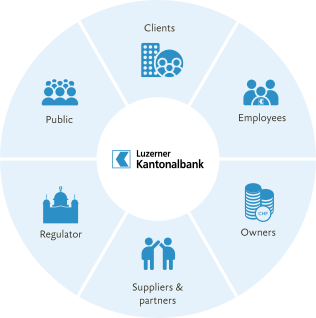
Engagement and dialogue with stakeholders
LUKB strongly believes in cultivating a close and regular dialogue with its stakeholders and in communicating transparently. This dialogue builds reciprocal trust. In addition, the needs, expectations and requirements placed on LUKB can be identified at an early stage and areas for improvement can be identified on the basis of these. The ‘Material topics in stakeholder engagement and dialogue’ table provides an overview of LUKB's engagement and dialogue with its stakeholders.
Material topics
In order to determine the relevant priorities, LUKB reviews its material topics at least once a year. Material topics are those sustainability aspects that are particularly important for a company due to their impact on the environment and society or their financial relevance. The last review of the material topics was conducted in September 2025 by an interdepartmental working group of specialists.
The review was based on the requirements set out in the Swiss Code of Obligations for non-financial reporting, in particular the double materiality approach. This includes both financial materiality from an outside-in perspective (financial materiality for LUKB) and impact materiality from an inside-out perspective (environmental and social materiality). In addition, the requirements set out in the relevant reporting standard of the Global Reporting Initiative (GRI 3 ‘Material topics’, 2021) were taken into account. The following were also used as a benchmark:
- LUKB strategy
- The LUKB Ownership Strategy of the Canton of Lucerne
- Information and findings from stakeholder engagement and dialogue
- Statutory and regulatory requirements and developments
- Relevant reporting standards and recommendations, particularly the standards set by the Global Reporting Initiative (GRI) and the climate reporting recommendations made by the Task Force on Climate-related Financial Disclosures (TCFD)
- United Nations Sustainable Development Goals (SDGs)
- Sector analyses
- External sustainability/ESG ratings and studies
- Media reports
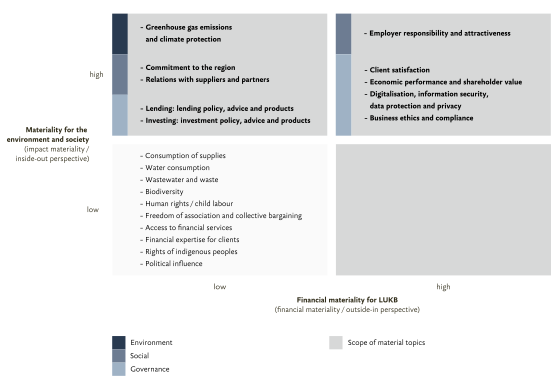
As a result of the review, the following ten topics were found to be material:
- Client satisfaction
- Economic performance and shareholder value
- Digitalisation, information security, data protection and privacy
- Business ethics and compliance
- Investing: investment policy, advice and products
- Lending: lending policy, advice and products
- Employer responsibility and attractiveness
- Commitment to the region
- Relations with suppliers and partners
- Greenhouse gas emissions and climate protection
The following materiality matrix shows the ten material topics, shown on the one hand according to financial materiality for LUKB (outside-in perspective, horizontal axis) and on the other hand according to materiality for the environment and society (inside-out perspective, vertical axis). The material topics are in the dark grey areas. Each material topic is covered individually in the following sections.
Material topics in stakeholder engagement and dialogue
Stakeholder | Material topics | Engagement/dialogue | Sections in this Sustainability Report | |||
|---|---|---|---|---|---|---|
Clients |
|
| Client satisfaction Digitalisation, information security, data protection and privacy Business ethics and compliance Investment business Lending business | |||
Employees |
|
| Employer responsibility and attractiveness Digitalisation, information security, data protection and privacy Business ethics and compliance | |||
Owners |
|
| Economic performance and shareholder value Business ethics and compliance | |||
Suppliers and partners |
|
| Relations with suppliers and partners Business ethics and compliance | |||
Regulator |
|
| Digitalisation, information security, data protection and privacy Business ethics and compliance Investment business Lending business | |||
Public |
|
| Commitment to the region Economic performance and shareholder value Greenhouse gas emissions and climate protection |
LUKB stakeholders and the UN SDGs
Of principal relevance to LUKB and its stakeholders are the seven United Nations Sustainable Development Goals (SDGs) shown below:
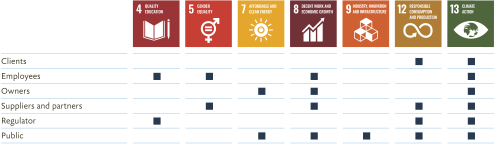
LUKB has less of an influence over the remaining ten SDGs, although its lending and investment activities may still contribute directly or indirectly in these areas. Further information on the SDGs can be found in the Annex to this Sustainability Report.
Material topics for LUKB and the UN SDGs
Material topic | Corresponding Sustainable Development Goal (SDG) | Sections in this Sustainability Report | ||||
|---|---|---|---|---|---|---|
Client satisfaction |
| E-WEB-Goal-08.png | ||||
Economic performance and shareholder value |
| E-WEB-Goal-08.png E-WEB-Goal-09.png E-WEB-Goal-12.png | ||||
Digitalisation, information security, data protection and privacy |
| E-WEB-Goal-08.png | Digitalisation, information security, data protection and privacy | |||
Business ethics and compliance |
| E-WEB-Goal-08.png | ||||
Investing: investment policy, advice and products |
| E-WEB-Goal-08.png E-WEB-Goal-09.png E-WEB-Goal-12.png | ||||
Lending: credit policy, advice and products |
| E-WEB-Goal-08.png E-WEB-Goal-09.png E-WEB-Goal-12.png | ||||
Employer responsibility and attractiveness |
| E-WEB-Goal-04.png E-WEB-Goal-05.png E-WEB-Goal-08.png | ||||
Commitment to the region |
| E-WEB-Goal-08.png | ||||
Relations with suppliers and partners |
| E-WEB-Goal-08.png | ||||
Greenhouse gas emissions and climate protection |
| E-WEB-Goal-13.png |