Consolidated notes
Luzerner Kantonalbank AG (LUKB) is a public limited company under private law in accordance with the Swiss Code of Obligations with its registered office in Lucerne. The LUKB Group has a dense branch network with 22 branches in the Canton of Lucerne and one office in Zurich (private banking and structured products). LUKB has two sales offices for its structured products business in the French- and Italian-speaking parts of Switzerland (Lausanne and Lugano).
General principles
The accounting and valuation principles comply with the Swiss Code of Obligations, the Swiss Banking Act and the related ordinance as well as the Accounting Ordinance of the Swiss Financial Market Supervisory Authority (FINMA) (FINMA AO) and the accounting rules for banks, investment firms, financial groups and conglomerates in accordance with FINMA Circular 2020/01 ‘Accounting – Banks’. The consolidated annual financial statements present a true and fair view of the assets, financial position and results of operations of the LUKB Group. The individual figures are rounded for publication. The calculations, however, were made on the basis of unrounded figures.
Scope of consolidation
The consolidated annual financial statements comprise the financial statements of the parent company as well as of the Group companies held directly or indirectly in which LUKB holds a majority of the voting rights or capital (see sections ‘Disclosures on significant participations’ and ‘Consolidation method’).
Consolidation method
The company mentioned in the ‘Fully consolidated participations’ paragraph in the ‘Disclosures on significant participations’ section is included in the consolidated financial statements using the full consolidation method. For capital consolidation, the valuation is carried out at the time of acquisition using the purchase method. Under this method, assets and liabilities as well as expenses and income are recognised in full. Significant non-controlling interests with holdings of between 20 % and 50 % are accounted for in the consolidated annual financial statements using the equity method. In the case of intermediate holdings, the holding amount is determined by reference to the operating unit. Any surplus of assets resulting from the initial valuation (goodwill) is recognised under ‘Intangible assets’ and amortised over its useful life. Capitalised goodwill is generally amortised over a period of five years or, in justified cases, over a maximum of ten years. Goodwill for which recognition is no longer warranted on the basis of an assessment as at the balance sheet date is additionally written down at the appropriate time. This assessment is carried out if there are indications of impairments. Intra-Group transactions are eliminated during the preparation of the consolidated annual financial statements. There are no interim profits.
Consolidation period
The consolidation period corresponds to the respective calendar year. If consolidated subsidiaries have financial years that differ from the calendar year, interim financial statements are prepared as at the balance sheet date.
Detailed provisions
General valuation principles
The valuation is based on the assumption that the Group and the Group companies are going concerns. Accordingly, the annual financial statements are prepared on a going-concern basis.
The items reported and included in a balance sheet item are valued individually. If the value of assets is impaired as at the balance sheet date, individual value adjustments and write-downs are recognised. The following items are valued at nominal value:
Balance sheet: Assets
- Liquid assets
- Amounts due from banks
- Amounts due from securities financing transactions
- Amounts due from clients
- Mortgage loans
Balance sheet: Liabilities
- Amounts due to banks
- Liabilities from securities financing transactions
- Amounts due in respect of customer deposits
- Cash bonds
- Bond issues and central mortgage institution loans
Off-balance sheet
- Contingent liabilities
- Irrevocable commitments
- Liabilities relating to calls on shares and other equity securities
- Credit commitments
- Fiduciary transactions
For credit-related default risks, value adjustments are recognised for assets, and provisions are established for off-balance-sheet items. Interest and discounts are accrued over time and recognised under ‘Gross result from interest business’.
As a general principle, there is no offsetting of assets and liabilities. However, assets and liabilities can be offset in the following cases:
- Receivables and liabilities, provided they arise from transactions of the same type with the same counterparty, have the same or earlier due date as the receivable, are denominated in the same currency and do not give rise to counterparty risk. These conditions must be fulfilled cumulatively;
- Positive and negative value adjustments not recognised in profit or loss in the adjustment account;
- Deferred income tax liabilities with deferred income tax assets, provided they concern both the same taxable entity and the same tax authority;
- Netting of positive and negative replacement values of derivative financial instruments and cash collaterals deposited in this context, provided that recognised and legally enforceable netting agreements exist.
Assets and liabilities are also offset in the following cases:
- Own debt securities with the corresponding liability position;
- value adjustments with the corresponding asset position;
- Sub-participations granted as the lead bank in a loan transaction with the corresponding principal claim.
As a general principle, there is no offsetting of expenses and income. However, expenses and income can be offset in the following cases:
- Newly formed value adjustments for default risks and losses from interest business with the corresponding recoveries and released value adjustments (reported under ‘Changes in value adjustments for default risk and losses from interest operations’);
- Newly formed provisions and other value adjustments and losses with the corresponding recoveries and released provisions and value adjustments (reported under ‘Changes to provisions and other value adjustments and losses’);
- Gains on trading activities and transactions measured using the fair value option with the losses on these transactions;
- Positive value adjustments of financial assets valued according to the lower-of-cost-or-market principle with the corresponding negative value adjustments;
- Expenses and income from real estate are reported under ‘Property income’;
- The refinancing result from trading activities under ‘Result from trading activities and the fair value option’;
- Income from hedging transactions with corresponding income from the hedged transaction;
Liquid assets
Liquid assets comprise coins, banknotes and sight deposits held at the Swiss National Bank and at FINMA-recognised clearing centres.
Amounts due from and liabilities from securities financing transactions
As part of repurchase transactions, the LUKB Group sells securities from the investment portfolio and money market book claims with a corresponding repurchase obligation and, as part of reverse repurchase transactions, buys securities with a corresponding selling obligation. Repurchase transactions are treated as cash deposits with the pledging of own securities, while reverse repurchase transactions are treated as advances secured by securities. Lending transactions with securities that are not collateralised by cash are not recognised in the balance sheet, but are disclosed in the notes.
Reimbursement claims and obligations from securities lending and borrowing arising from cash contributions posted or received for borrowed or loaned non-monetary securities are also disclosed under ‘Amounts due from securities financing transactions’ and ‘liabilities from securities financing transactions’. Expenses and income arising in connection with securities lending and borrowing (e.g. compensation payments for dividends or interest on lent securities) are recognised under ‘Result from trading activities and the fair value option’.
Amounts due from banks, amounts due from clients and mortgage loans
Value adjustments are made for identifiable risks of loss, whereby specific value adjustments for impaired loans/receivables and value adjustments for inherent default risks on non-impaired loans/receivables (including those for country risks) are offset against the loans/receivables. The methods used for determining value adjustments are described in Section 4 ‘Methods used for identifying default risks and determining the need for value adjustments and provisions’. As mentioned in Section 4, the basis for determining the value adjustment of loans/receivables is at least the agreed credit limit. The use of this limit for overdraft facilities is typically subject to frequent and significant fluctuations. For this reason, the entire value adjustment (both for the loan/receivable portion and the unused limit portion) is recognised for the first time under ‘Changes in value adjustments for default risk and losses from interest operations’. The corresponding offsetting entry is made:
- in the amount of the loan/receivable less any liquidation proceeds from collateral as a value adjustment to the corresponding balance sheet item,
- in the amount of the unused limit or of the remaining value adjustment as a provision.
This means that loans to customers are recognised in the balance sheet at least to the extent of the recoverable collateral.
If the amount of the loan/receivable and thus also the proportion of the unused limit changes, the corresponding amount is reclassified between the value adjustment on the corresponding balance sheet item and the provision without affecting profit or loss. This reclassification is shown in the column ‘Reclassifications’ in Table 8.14 ‘Value adjustments and provisions / reserves for general banking risks’. The value of the impaired loan/receivable is adjusted as mentioned in Section 4, taking into account any liquidation proceeds from collateral. As a result, the impaired loan/receivable remains on the balance sheet in the amount of the liquidation proceeds. Recoveries on impaire loans/receivables are offset directly against value adjustments or provisions for credit risks. Value adjustments and provisions that are no longer required are reversed under ‘Changes in value adjustments for default risk, and losses from interest operations’.
Trading portfolio assets and liabilities
Securities, precious metals and cryptocurrencies that are actively managed and therefore held for current trading purposes are valued at fair value as at the balance sheet date (value on a price-efficient and liquid market). Valuation gains or losses form part of ‘Result from trading activities and the fair value option’. Interest and dividend income is likewise reported under ‘Result from trading activities and the fair value option’. Securities purchases made in connection with the hedging of structured products issued by LUKB form an integral part of the trading business. For the treatment of own debt and equity securities, please refer to the corresponding Section.
Positive and negative replacement values of derivative financial instruments
The positive and negative replacement values of derivative financial instruments are recognised as follows:
Hedging transactions
Derivative financial instruments are used to hedge interest-rate risks and value fluctuations of equity securities in financial assets. The principles and hedge accounting are described in the Section ‘Use of derivative financial instruments / hedge accounting’.
The accrual method is applied to the derivative financial instruments used to hedge interest-rate risks as part of asset & liability management (ALM). The result from derivative hedging transactions is allocated to the same income item as income from the underlying transaction.
The result from macro hedges in the interest-rate hedging area, together with the interest income from currency swaps concluded in the banking book, is included in interest income or expenses under ‘Result from interest-rate hedging and other derivative transactions’.
During the tenor of the hedging transactions, for as long as they are deemed effective, the result of the hedging of equity securities in financial assets is booked on a lump-sum basis to a settlement account recognised under financial assets. After expiry or termination of the hedging, the cost prices of the hedged securities are adjusted by the total effective hedging result in proportion to the carrying amounts of the hedged securities. Hedging transactions that are ineffective or only partially effective are treated as trading transactions to the extent of the ineffective portion.
The replacement values of derivative hedging instruments are booked under ‘Other assets’ or ‘Other liabilities’ against the compensation account. Accrued interest on hedging positions is also included in the compensation account. The net balance of the compensation account from interest-rate hedges is reported under ‘Other assets’ or ‘Other liabilities’.
Interest-rate-risk hedges in the banking book are executed via the Trading & Treasury Services (Trading) organisational unit. Interest income from currency swaps concluded in the banking book is reported under ‘Result from interest-rate hedging and other derivative transactions’ under ‘Gross result from interest operations’. For this purpose, Trading concludes the corresponding derivative financial instruments with external counterparties. While the foreign-exchange result is allocated to trading activities, the interest income is recognised in the banking book (‘Gross result from interest operations’). These transactions are shown as trading instruments in Section 8.4 ‘Derivative financial instruments (assets and liabilities)’.
Trading business
The market value principle is applied to trading transactions, provided the contracts are listed on the stock exchange or a representative market exists. Unlisted derivative financial instruments are valued on a discounted-cash-flow basis or using option-pricing models. Realised and unrealised gains or losses from derivative financial instruments held for trading purposes are recognised under ‘Result from trading activities and the fair value option’, while positive or negative replacement values are recognised in the corresponding balance sheet item.
Commission business
In addition to derivative business for its own account as a proprietary trader, LUKB also engages in commission business with clients. The replacement values are accounted for according to the following rules:
- Over-the-counter (OTC) trading: All replacement values of derivative financial instruments are recognised in the balance sheet.
- Exchange traded: Only the replacement values of the derivative financial instruments sold by clients are recognised in the balance sheet (and the offsetting position as derivative financial instruments purchased on the stock exchange).
Other financial instruments at fair value and liabilities from other financial instruments at fair value
Financial instruments that are not part of the trading business but are nevertheless valued at fair value are recognised under ‘Other financial instruments at fair value’.
Self-issued structured products for which the fair value option has been selected within the meaning of Art. 18 para. 2 FINMA AO are treated as a unit and recognised under the balance sheet item ‘Liabilities from other financial instruments at fair value’.
With the exception of the valuation gain or loss on own shares in self-issued trackers, changes in valuation are recognised in ‘Result from trading activities and the fair value option’, while the interest expense is recognised under ‘Gross result from interest operations’. The gain or loss from the valuation of own shares in self-issued trackers is deferred over the tenor and, upon realisation, recognised in equity as per the Section ‘Own debt and equity securities’.
Financial investments
Securities acquired with the intention of long-term investment are valued in accordance with the lower-of-cost-or-market value principle. Debt securities acquired with the intention of holding to maturity are subject to the accrual method, i.e. any premium or discount is discounted or compounded over the tenor to maturity. In the event of an early sale or an early redemption, interest components are also accrued over the residual tenor of these securities in the same way. Any ratings-based value adjustments are recognised in the income item ‘Changes in value adjustments for default risk and losses from interest operations’. Physical precious metals held under financial assets to hedge holdings in the metal accounts of banks and clients are measured at fair value.
All debt securities in the form of convertible and warrant bonds, debt securities held with the intention of selling as well as all equity securities including investment funds are valued in accordance with the lower-of-cost-or-market principle, i.e. at the lower of acquisition cost or market price. Market-related value adjustments and hedging results are recognised under ‘Other ordinary income or expenses’. Any payments received as a result of nominal capital reductions on equity securities are used to reduce the acquisition costs and therefore are not recognised as income. Properties acquired through the lending business and intended for resale are valued in accordance with the lower-of-cost-or-market principle (acquisition cost or, where applicable, a conservatively estimated lower liquidation value). Any necessary adjustments in the value of financial assets valued under the lower-of-cost-or-market principle are recognised under ‘Other ordinary income or expenses’, with a maximum of one write-up up to the cost of acquisition.
For the treatment of own debt securities and equity securities, please refer to the corresponding Section ‘Own debt and equity securities’.
Non-consolidated participations
Significant non-controlling interests with holdings of 20 % to 50 % are recognised in the consolidated annual financial statements at proportionate equity on the balance sheet date in accordance with the equity method (see also the ‘Consolidation method’ section). Income from investments accounted for using the equity method is recognised in the income statement under ‘Income from participations accounted for using the equity method’, while negative value adjustments are charged to ‘Value adjustments on participations and depreciation and amortisation of tangible fixed assets and intangible assets’. Companies in which LUKB holds a stake of less than 20 % or the size of which does not have a material impact on the consolidated annual financial statements are carried at the lower of cost or market value. This category includes, in particular, investments in joint institutions of banks and in local institutions in the Canton of Lucerne.
Investments in smaller, local institutions are generally written down immediately to a nominal value of one Swiss franc. Value adjustments relating to this are recognised under ‘Value adjustments on participations and depreciation and amortisation of tangible fixed assets and intangible assets’. Realised gains and losses from the sale of investments are recognised under ‘Extraordinary income’ or ‘Extraordinary expenses’.
Non-consolidated participations are listed – where material – in the Section ‘Disclosures on significant participations’.
Tangible fixed assets – real estate
Bank buildings and other properties recognised under ‘Tangible fixed assets’ are carried at no more than acquisition cost less straight-line depreciation over their useful life down to a residual value. The respective estimated useful lives within the Group are as follows:
- Land: n/a, no depreciation
- Building or envelope: 33 years
- Interior fittings: 20 years
- Technical installations: 10 years
The residual value corresponds to the land value and a maximum supplement of 25 % of the investment amount in the building envelope. A potentially lower market value, measured individually for each property, always constitutes the upper limit for recognition in the balance sheet, i.e. additional depreciation is recognised down to the market value in this case. Where there are indications of impairment, a review is carried out at each balance sheet date to determine whether the value of the properties has been impaired.
IT software
One-off licences for IT software are capitalised under ‘Tangible fixed assets’ if the threshold of 100,000 Swiss francs is exceeded and the software is used for more than one accounting period. Depreciation is recognised on a straight-line basis over the conservatively estimated useful life from the actual commencement of operational use as follows:
- Core banking software: maximum 5 years
- Special software: maximum 3 years
Investment volumes of less than 5 million Swiss francs are usually written down immediately. If there are indications of impairment, the value in use must be assessed and, if necessary, an additional write-down is recognised.
Other tangible fixed assets
Other tangible fixed assets are capitalised if they are used for more than one accounting period and exceed the capitalisation threshold of 100,000 Swiss francs. Depreciation is recognised immediately or on a straight-line basis over the useful life. The respective estimated useful lives within the Group are as follows:
- Operating equipment incl. client safes: maximum 10 years
- Office furniture: maximum 5 years
- Office machines: maximum 4 years
- Telecommunications / workplace technology: maximum 4 years
- IT hardware: maximum 4 years
- Software integration costs: maximum 4 years
The effective depreciation period is defined at the start of each project. Ordinary depreciation is recognised on a straight-line basis over the fixed useful life. Investment volumes of less than 5 million Swiss francs are usually written down immediately. If there are indications of impairment, the value in use must be assessed and, if necessary, an additional write-down is recognised.
Write-ups are made when the reason for extraordinary depreciation ceases to exist. Realised gains and losses are recognised in the income statement under ‘Extraordinary income’ or ‘Extraordinary expenses’.
Intangible assets
For the treatment of any goodwill arising from the initial consolidation of a company, please see the Section ‘Consolidation method’. Other acquired intangible assets are capitalised if they provide a benefit over several accounting periods and exceed the capitalisation threshold of 100,000 Swiss francs. The effective depreciation period is defined at the time of initial capitalisation. Ordinary depreciation is recognised on a straight-line basis over the fixed useful life. If there are indications of impairment, the value in use must be assessed and, if necessary, an additional write-down is recognised. Realised gains and losses are recognised in the income statement under ‘Extraordinary income’ or ‘Extraordinary expenses’.
For the categories Tangible fixed assets – real estate, IT software, Other tangible fixed assets and Intangible assets, ordinary and extraordinary depreciation is recognised under ‘Value adjustments of participations and depreciation and amortisation of tangible fixed assets and intangible assets’.
LUKB had not capitalised any intangible assets as at 31 December 2025.
Provisions
Corresponding value adjustments and provisions are formed for all risks identified on the balance sheet date in accordance with the Section ‘General principles’. Provisions no longer required for business purposes are reversed through profit or loss. The creation and release of pension provisions are recognised under ‘Personnel expenses’, while other provisions are recognised under ‘Changes to provisions and other value adjustments and losses’. Provisions are recognised for inherent default risks on unimpaired contingent liabilities. The methods used for determining the corresponding provisions are described in Section 4 ‘Methods used for identifying default risks and determining the need for value adjustments and provisions’. For deferred taxes, please see the Section ‘Taxes’.
Pension obligations
The employees of the LUKB Group are insured with the pension fund of Luzerner Kantonalbank. A management insurance scheme (affiliation to a collective foundation) also exists. As at 31 December 2025, five employees were covered by this management insurance.
LUKB bears the employer's costs of occupational pension schemes for employees and their surviving dependants in accordance with statutory and regulatory provisions. All pension plans are defined contribution plans. The pension obligations and the assets serving as collateral are placed in legally independent foundations. Employer contributions from these pension plans are recognised in ‘Personnel expenses’ on an accrual basis.
Each year, an assessment is made for each pension plan as to whether, from the perspective of LUKB, a pension institution represents an economic benefit or an economic obligation. This economic benefit (under ‘Other assets’) or the economic obligation (under ‘Provisions’) of the individual pension plans are recognised in the balance sheet (however, an obligation only exists if the conditions for recognising a provision are met). The difference compared with the prior-period value is recognised in ‘Personnel expenses’. The annual financial statements of the pension institutions, which are prepared in accordance with Swiss GAAP FER 26, serve as the basis for determining the benefit or obligation. These present the financial situation as well as the existing surplus or deficit in accordance with the actual circumstances of the respective pension institution. Further information can be found in the ‘Provisions from pension obligations’ section below and Section 8.11 ‘Economic situation of own pension institutions’.
Provisions from pension obligations
For members of senior management promoted before 1986 and for members of the Executive Board promoted before 1990, an internal pension fund is maintained for fixed-salary components that were not insured by the pension fund. The benefits are based on the last insured salary before retirement and comprise old-age pensions and survivors' pensions. Instead of a pension benefit, the beneficiary was able to opt for a one-off lump-sum payment upon retirement.
This internal pension fund was discontinued in connection with the change in the pension plan of Luzerner Kantonalbank (a defined contribution plan has been in force since 1 January 2002). As at 31 December 2025, it still had five beneficiaries. In prior years, the necessary provisions for the beneficiaries' old-age and survivors' pensions were recognised in the income statement. Since 2010, no additional interest has been credited to the pension capital.
Reserves for general banking risks
The reserves for general banking risks are allocated to a separate account and counted as equity capital. They are disclosed accordingly in the ‘Consolidated statement of changes in equity’ section and in Section 8.14 ‘Value adjustments and provisions / reserves for general banking risks’.
Own debt and equity securities
Own bonds and cash bonds are offset against the corresponding items reported under liabilities. Interest income from own bonds and cash bonds is offset against interest expenses without affecting profit or loss. Own shares are deducted from equity at acquisition cost under ‘Own shares’. Own shares held for hedging purposes for self-issued trackers are also included in this balance sheet item. Any payments received from a nominal capital reduction for own shares are used to reduce the acquisition costs. Dividend payments and gains from disposals are allocated to the ‘Capital reserve’.
Participation programmes
Part of the variable compensation of the Executive Board and senior management is paid out via a share participation programme. In addition, the Bank may periodically grant all employees the right to acquire a limited number of employee shares. Expenses resulting from the participation programmes are based on valuations at market prices without taking into account any deduction for vesting periods and are included in ‘Personnel expenses’. Further information on the structure of the programmes can be found in the Compensation Report.
Contingent liabilities, irrevocable commitments, liabilities for calls on shares and other equity, credit commitments
Off-balance-sheet transactions are disclosed at nominal value. Provisions are recognised in the balance sheet for foreseeable risks. Regarding the methodology used to determine these provisions, see Section 4 ‘Methods used for identifying default risks and determining the need for value adjustments and provisions’.
Securities and fiduciary investments
Securities and uncertificated securities, coins and precious metals, exchange-traded derivative financial instruments and structured products as well as cryptocurrencies in open client custody accounts are included under this item. Cryptocurrencies are assigned to a collective pool in accordance with Art. 16 para. 1bis letter b of the Swiss Banking Act and it can be seen which share of the collective assets is attributable to each custody-account client. Cryptocurrencies can therefore be segregated in the event of the bank's bankruptcy. Fiduciary transactions are investments or loans executed or granted by Group companies in their own name but for the account and risk of the client.
Taxes
Tax expenses comprise current and deferred taxes. Current taxes are determined in accordance with the relevant tax laws and are charged to the income statement in the reporting period in which the respective profits arise. Deferred tax assets and liabilities are calculated for temporal differences between the carrying amounts of assets and liabilities recognised in the ‘Consolidated balance sheet’ and the carrying amounts recognised by the tax authorities. These are determined separately for each business period and for each taxable entity. Deferred tax assets are only recognised if they can be realised in the short term. Changes in deferred taxes are recognised in the income statement and disclosed in Section 10.12 ‘Taxes and tax rate’. Both the current income and capital tax expenses and the change in deferred taxes within ‘Provisions’ are recognised under ‘Taxes’.
Changes in accounting and valuation principles
In the 2025 financial year, LUKB made the following changes to its accounting and valuation principles:
- From the 2025 financial year onwards, provisions for inherent default risks on off-balance-sheet items (contingent liabilities) are now recognised. For further details, see Section 4 ‘Methods used for identifying default risks and determining the need for value adjustments and provisions’
- Positive and negative replacement values of derivative financial instruments and cash collaterals for each counterparty deposited in this context are now also offset against each other in the balance sheet, provided that recognised and legally enforceable netting agreements exist. The previous year's figures have been restated as follows for comparison purposes:
Change | ||||||||
Amounts in 1,000 Swiss francs | 31.12.2024 previously | 31.12.2024 new | absolute | in % | ||||
Assets | ||||||||
Amounts due from banks | 383,621 | 346,240 | – 37,381 | – 9.7 | ||||
Loans to customers | 43,402,869 | 43,374,016 | – 28,853 | – 0.1 | ||||
Amounts due from clients | 5,167,446 | 5,138,593 | – 28,853 | – 0.6 | ||||
Positive replacement values of derivative financial instruments | 416,540 | 174,381 | – 242,159 | – 58.1 | ||||
Total assets | 59,462,485 | 59,154,092 | – 308,393 | – 0.5 | ||||
Liabilities | ||||||||
Amounts due to banks | 4,120,147 | 4,102,377 | – 17,770 | – 0.4 | ||||
Amounts due in respect of customer deposits | 29,101,723 | 29,101,601 | – 122 | – 0.0 | ||||
Negative replacement values of derivative financial instruments | 480,946 | 190,445 | – 290,501 | – 60.4 | ||||
Total liabilities | 59,462,485 | 59,154,092 | – 308,393 | – 0.5 | ||||
- From the 2025 financial year onwards, brokerage commissions for loans paid to brokers and platforms are no longer recognised in the commission and service business, but rather are offset directly against the corresponding interest income. In the 2024 financial year, the corresponding commission expenses amounted to 1.0 million Swiss francs.
- In addition, the dedicated reserves for general banking risks were combined with the reserves for general banking risks not intended for a specific purpose as at 31 December 2025. Accordingly, the total amount of the reserves for general banking risks is now without purpose-specific allocation.
Recognition of transactions
All transactions concluded are recognised on the trade date and valued in accordance with the provisions in the Sections ‘Foreign-currency translation’ and ‘Detailed provisions’. Accordingly, the net income is also included in the income statement from the trade date onwards. Derivative financial instruments (with the exception of transactions settled via the continuous linked settlement system [CLS]) are derecognised two days before maturity on accounts opened in the name of the counterparty. CLS-eligible foreign exchange transactions are derecognised on the settlement date.
Treatment of past due interest
Unpaid interest and commissions overdue by more than 90 days are not included in ‘Interest and discount income’ but allocated directly to value adjustments. Likewise, the accrued interest on these items is not included in ‘Gross result from interest operations’. In addition, loans are placed interest-free if it appears unlikely that the interest can be collected.
Foreign-currency translation
Receivables and liabilities in foreign currencies and precious metals as well as foreign currency holdings for the foreign exchange business are valued in the individual financial statements of the Group companies at the average exchange rates applicable on the balance sheet date and applied uniformly throughout the Group. The exchange-rate gains and losses resulting from this valuation practice are reported under ‘Result from trading activities and the fair value option’. Transactions in foreign currencies are translated at the prevailing exchange rate and any resulting gains and losses are recognised in the income statement. The exchange rates applied uniformly across the LUKB Group as at the reporting date were:
Unit | Currency code | 31.12.2025 | 31.12.2024 | |||
1 US-Dollar | USD | 0.793 | 0.906 | |||
1 pound sterling | GBP | 1.067 | 1.134 | |||
1 Euro | EUR | 0.931 | 0.938 | |||
100 Japanese yen | JPY | 0.506 | 0.576 |
Refinancing of positions in trading business
Interest and dividend income from trading activities is disclosed under ‘Result from trading activities and the fair value option’. By contrast, the refinancing result for trading activities (funding), which is calculated on the basis of the tom/next interest rate, is recognised under ‘Result from trading activities and the fair value option’ and under ‘Refinancing result from trading positions’ within ‘Interest and discount income’.
Risk policy
As a financial institution, LUKB is confronted with various bank-specific risks: these include default, market, liquidity, operational, compliance, strategic and reputational risks. Sustainability risks (ESG) as well as climate risks and other nature-related financial risks are not a separate risk category, but rather drivers of the risk categories listed above.
Dealing with risks is one of LUKB's core activities. The appropriate management of risk is of great importance. The risk policy adopted by the Board of Directors defines the framework concept for bank-wide risk management in accordance with FINMA Circular 2017/01 ‘Corporate governance – banks’.
In line with its corporate strategy, LUKB endeavours to handle risks prudently. To this end, LUKB defines sustainable risk policy requirements, even if that means it does not follow all the trends. Accordingly, LUKB only engages in transactions for which it can be ensured that the bank has the basis for controlling the associated risks. In doing so, LUKB aims not only to protect its financial strength, but also to preserve its reputation. LUKB continuously develops its staff through regular training sessions so that all employees attach great importance to risk management.
The following information takes into account the qualitative information required by the FINMA Ordinance on Disclosure Obligations of Banks and Securities Firms (DisO-FINMA). Explanations of the credit, market and operational risk approaches applied to the calculation of capital adequacy, as well as information on quantity, can be found in the separate Disclosure Report 2025.
The Board of Directors is the highest governing body in the risk management organisation. It determines the risk policy and defines the risk strategy, risk identification, risk measurement, risk assessment, risk management and risk monitoring as well as the principles of the risk management organisation with regard to the independent Compliance and independent Risk Control functions. It also determines risk tolerance and approves strategic limits for the individual risks within the various risk categories, based on LUKB's risk-bearing capacity. When setting the strategic risk limits, care is taken to ensure that the legally required capital is maintained even if various negative events occur. Risk monitoring and compliance with the risk policy by the highest governing body are ensured by means of periodic and standardised reporting at the appropriate level and by providing immediate information in exceptional cases (for further information, please refer to the explanations in the section on corporate governance ‘Internal organisation’). The Board of Directors reviews the risk policy periodically – at least once a year – and adjusts it if necessary.
The Risk and Strategy Committee of the Board of Directors prepares the basis for decisions to be made on risk policy (principles and structure of the internal control system as well as determining the risk profile, risk-bearing capacity and risk appetite). It also assesses LUKB's overall risk situation and monitors the appropriateness of the risk policy and its implementation. The Risk and Strategy Committee of the Board of Directors defines the risk policy requirements in further detail in corresponding risk sub-policies. These are reviewed periodically – at least every two years – by the Risk and Strategy Committee of the Board of Directors and adjusted if necessary.
The Audit and Finance Committee of the Board of Directors forms an independent opinion on the internal audit, the external auditors, the internal control system (ICS) and the annual financial statements. It monitors compliance with legal and regulatory requirements.
The Group Executive Board is responsible for implementing the risk policy and risk sub-policies and thus for developing adequate systems and suitable processes for identifying, measuring, assessing, managing and monitoring the risks assumed by the Group. This also includes allocating the risk limits approved by the Board of Directors to the individual business areas, delegating the corresponding competencies and specifying the activities of the Risk Control and Compliance functions. The Group Executive Board regularly reviews the appropriateness of the internal control system and thus also the effectiveness of risk management.
Risk Control function
LUKB has a centrally managed risk function that is independent of income-oriented business activities and also performs the Risk Control function. It is responsible for all risks in the Group and has the following duties:
- Concept: Design of the risk system, the ICS measures in the processes in terms of methodology, principles and requirements as well as the risk-bearing capacity, risk tolerance and risk limits
- Independent risk control: Control of limits in accordance with risk policy and associated rules. Approval of management instruments and risk models as well as risk assessment of bank changes for the attention of the decision-making body
- Risk reporting: Reporting on the risk situation and compliance with limits in accordance with the risk policy and associated rules.
Risk Control reports directly to the CEO. It reports quarterly by means of a risk report covering all risk categories to the Group Executive Board, the Risk and Strategy Committee of the Board of Directors as well as to the Board of Directors. A risk assessment and a comparison of the current situation with the corresponding limits are carried out for each risk category. In the event of extraordinary events or limits being exceeded, an extraordinary report (exception report) is sent immediately to the responsible decision makers.
Compliance function
LUKB has a centrally managed Compliance function for the Group that is independent of income-oriented business activities. This supports the Group Executive Board and employees in enforcing and monitoring compliance. The Compliance function identifies and assesses compliance risk and reports on changes in compliance risk as well as on serious compliance breaches. The Compliance function reports directly to the CEO. It reports annually to the Group Executive Board, the Audit and Finance Committee of the Board of Directors as well as the Board of Directors on its activities in the previous reporting period and on the assessment of compliance risk. In the event of extraordinary events, an exception report is sent immediately to the responsible competence levels.
Internal audit
The internal auditors report to the Board of Directors. The Board of Directors approves the risk-oriented annual budget and the annual activity report of Internal Audit. The Audit and Finance Committee of the Board of Directors is responsible for managing Internal Audit. Internal Audit regularly audits the ICS. The audit reports of Internal Audit are considered by the Audit and Finance Committee of the Board of Directors, which, if necessary, initiates additional measures in addition to the measures provided for in the reports.
Internal control system (ICS)
LUKB's ICS, which is defined in its risk policy, encompasses all tasks and processes that ensure the achievement of business policy objectives and proper operations.
The LUKB ICS consists of three levels:
- First and foremost, the ICS ensures appropriate risk management in all banking processes by systematically identifying, measuring, evaluating, managing and controlling risks.
- Secondly, the Risk Control and Compliance functions, which are independent of the income-oriented business activities, control the business processes.
- Thirdly, Internal Audit performs the audit of the entire bank.
Outside the bank's actual risk organisation, an audit firm audits the institution.
Managing risks
Default risks
Default risk (credit risk) refers to the risk of financial loss if a counterparty is unable or unwilling to meet its contractually agreed obligations temporarily or permanently. Default risks can be caused by counterparty-specific factors, disruptions to the settlement process (settlement risk, e.g. settlement risk in foreign exchange transactions) or economic and political difficulties in a country (country risk).
Default risks exist both in the actual lending business (loans, fixed loan commitments and contingent liabilities) and in the interbank and trading business (derivatives such as forward transactions, options and swaps, financial assets and repo transactions).
Methodology and instruments
The lending business is based on the risk sub-policies for non-banks, banks and countries adopted by the Risk and Strategy Committee of the Board of Directors and reviewed if necessary (at least every two years), as well as the accompanying detailed directives. This sets out the target client segments, the main products and their principles, the credit approval and monitoring process, standards and restrictions as well as limits for positions entered into and the ratings applied (for commercial clients, banks and countries).
Default risks in relation to loans to customers
The approval authority for all transactions is determined by the definition of areas of responsibility for the lending business. Depending on the structure of the business, certain loans can be approved directly within the market area (e.g. by client advisors). These transactions are subsequently audited by Central Credit Risk Management on the basis of random checks in order to assess compliance with risk and authority (second opinion). All other lending transactions are only approved after review by Central Credit Risk Management, or Credit Risk Management prepares the lending transactions for approval by the authority level (e.g. for the Credit Committee consisting of the heads of department).
Central Credit Production, which is independent of the client advisors and Credit Risk Management, is responsible for correctly recording data, checking collateral and contracts, suspending limits, the final checking of limit availability and disbursement. In doing so, it ensures that the loan processing also complies with the loan approval requirements.
Companies subject to the obligation to keep accounts are also subject to a rating process by the CreditMaster system (RSN Risk Solution Network AG). In the case of large companies, the key financial figures are supplemented with qualitative assessments of strategy and management. Five rating systems are available, for large companies (production and trading/services), for small companies (production and trading/services), and one for real estate companies. For the purposes of risk assessment and early detection, commercial client credit ratings are periodically updated and assessed on the basis of the annual financial statements to be submitted.
Overdue, impaired or non-performing loans/receivables are (co-)managed by specialists from Special Financing. The aim is to minimise the risk of default. Lending transactions outside the usual standard (exception to policy transactions) require increased attention and a special definition of areas of responsibility as part of the approval process. The Group Executive Board and the Risk and Strategy Committee of the Board of Directors receive a corresponding quarterly report on new business. Exception to policy (EtP) includes loans that do not comply with one or more of the following requirements upon their granting:
- Loan-to-value ratio outside defined limits (e.g. residential investment properties >75 %, building land >60 %)
- Affordability outside of defined thresholds (e.g. home financing: imputed costs exceed 34 % to 40 % of net income [depending on the level of net income])
- Amortisation is below the defined target in accordance with the risk sub-policy for non-banks. The individual property is considered in each case, even if no amortisation would be necessary in a portfolio analysis.
Default risks in interbank business
In interbank business, a multi-level, system-supported limit system is used to manage counterparty risks. This system differentiates between del credere and settlement risks. The amount of the limit depends on the rating of the counterparty and its capital adequacy. The limit system is structured in such a way that adequate diversification of counterparties is taken into account. Depending on the risk situation of the counterparty and the market situation, interbank transactions are settled selectively against collateral (repo). In addition, collateral agreements (Credit Support Annex – CSA) are concluded with the counterparties as part of the ISDA agreements. Compliance with the limits is checked daily.
Country risks
Foreign exposures comprise all assets with a foreign risk domicile at their carrying amount or, in the case of derivatives, at their replacement value plus add-ons. Based on country ratings, management is carried out using a multi-stage limit system that takes account of adequate diversification. Compliance with limits is checked on a monthly basis.
Market risks
‘Market risk‘ refers to the loss potential resulting from unfavourable changes in interest rates, share prices, foreign exchange and cryptocurrency rates and real estate prices as well as other relevant market parameters such as volatilities. Market risks are present in both the banking and trading books.
Methodology and instruments
Market risks are managed via the modified duration of the present value of equity (banking book), value-at-risk limits (banking and trading books) and other limits. These are supplemented by periodic scenario analyses and stress tests.
Market risk management is essentially based on the risk sub-policies on asset & liability management (ALM) and trading adopted by the Risk and Strategy Committee of the Board of Directors and reviewed if necessary (but at least every two years), as well as the associated detailed directives.
Market risks in the banking book
Due to LUKB's strong positioning in the interest margin business, interest rate risk represents a significant risk. Interest-rate risks may arise due to temporal mismatches in the fixed-interest period or the interest rate restatement of assets, liabilities and off-balance-sheet items (interest rate restatement risk) or from changes in the balance sheet structure as well as changes in the interest rates for instruments that have a similar tenor but are valued on the basis of different interest rates (basic risk). Interest-rate risk is managed by the Asset & Liability Committee (ALCO), consisting of the heads of department, at the request of the ALCO preparatory committee. As part of the monitoring activities performed by the Finance department, the interest-rate risk metrics and the draw-down of the defined limits are determined monthly and reviewed by the independent Risk Control function. Callable positions or positions that are due on demand are taken into account in the individual parameters using a replication model that is to be reviewed annually. In addition, a dynamic analysis of the income effect is carried out quarterly based on various scenarios. The results of regular stress tests round off the decision-making basis for managing interest-rate risk. Derivative financial instruments are also used as part of asset & liability management (ALM) to manage and hedge interest-rate risks. For further information on the management of interest rate-risks, please refer to the ‘Interest-rate risks in the banking book’ section of the 2025 Disclosure Report.
In addition to interest-rate risk, other market risks must be managed in the banking book. The foreign currency risk of balance sheet items in the banking book is part of the trading book and is limited by the value-at-risk limits of the trading book (see the following Section ‘Market risks in the trading book’). The risks arising from financial investments and real estate are managed using a limit system (position and loss limits as well as risk spread limits). Financial investments mainly comprise good-quality listed securities traded on recognised markets. The vast majority are interest-bearing securities (see Section 8.5 ‘Financial investments’).
Market risks in the trading book
LUKB maintains a trading book with holdings of securities, foreign currencies, cryptocurrencies, interest-bearing securities and the respective derivatives that are subject to price fluctuations or their volatility. The derivative components and the corresponding hedges of the structured products issued by LUKB also form an integral part of the trading book. In addition, the foreign currency risk of balance sheet items in the banking book is managed via the trading book.
Market risks in the trading book are managed in the Trading & Treasury Services and Structured Products Trading organisational units, while limits are monitored by the independent Risk Control function. The limits are checked daily to ensure they are being adhered to. In addition to volume and sensitivity limits, value-at-risk limits are applied at the level of total trading and at the level of individual trading desks (securities and money trading, foreign exchange trading and structured products) at a confidence level of 99 % with a holding period of one day. The forecasting quality of the value-at-risk model is checked with a daily backtest.
Liquidity risks
Liquidity risk refers to the risk that the bank will be unable to refinance its assets (and increases thereof) or meet its obligations on prevailing market terms. Liquidity risks may arise for the bank as a result of unexpected events. Examples include the unscheduled use of credit limits by clients, outflows of client funds and the cancellation of refinancing limits by counterparties.
Methodology and instruments
Liquidity risks are managed as part of asset & liability management (ALM). Liquidity risk management is essentially based on the ALM risk sub-policy and internal directives adopted by the Risk and Strategy Committee of the Board of Directors and reviewed if necessary (but at least every two years). While the short-term management of liquidity on the money market is the responsibility of Trading, long-term refinancing is carried out in Treasury.
The Finance department periodically determines the utilisation of the limits and targets set by the Board of Directors for liquidity management with regard to the liquidity coverage ratio and net stable funding ratio as well as other liquidity risk parameters and reports these to the ALCO preparatory committee, ALCO, Trading and the independent Risk Control function. The independent Risk Control function reviews the information and reports it to the Group Executive Board, the Risk and Strategy Committee of the Board of Directors as well as the Board of Directors as part of the quarterly risk report. In addition, Risk Control regularly conducts liquidity stress tests together with the Finance department. A contingency plan is in place for unexpected liquidity events.
Short-term and structural liquidity
Through prudent liquidity management, LUKB aims to maintain a solid liquidity position to ensure that it is always able to meet its payment obligations on time. With regard to the development of the liquidity coverage ratio (LCR) and net stable funding ratio (NSFR), we refer to the 2025 Disclosure Report (see Section ‘LIQ1: Information on the liquidity coverage ratio (LCR)’ and ‘LIQ2: Information on the net stable funding ratio (NSFR)’).
In addition to the aforementioned minimum regulatory requirements, the liquidity risk is managed via internal limits and target values.
Operational risks
An operational risk is the risk of financial losses incurred as a result of the inadequacy or failure of internal processes or systems, improper actions or errors made by employees, or as a result of external events.
Methodology and instruments
The operational risks sub-policy, which is reviewed by the Risk and Strategy Committee of the Board of Directors as required (but at least every two years), and the associated guidelines essentially form the basis for managing operational risks.
Operational risks are identified and quantified by means of a structured self-diagnosis carried out by Risk Control with the process owners. They are classified according to loss event categories in accordance with the framework of the Basel Committee on Banking Supervision or FINMA. In order to measure the risks, the potential extent of damage must be determined both under normal circumstances (95 % of the possible risks that can occur in the normal course of business) and in the event of the occurrence of extreme cases (risks with a very high potential for damage and a low probability of en event occurring). Risk Control also maintains a claims database of losses that have occurred.
In order to manage the risk, the possible loss events are divided into four different risk zones. Based on this risk assessment, appropriate measures are then defined to mitigate the identified potential losses.
In accordance with the Operational Risks sub-policy, authority for approving operational risks and their management measures is derived from the risk assessment and, depending on the risk zone, lies with the process owners, the Group Executive Board or the Board of Directors.
Operational risks are managed and the risks and ICS are documented in a specialised GRC tool for which Risk Control is responsible. The persons responsible for performing the controls also send control reports from the inventoried downstream controls directly to Risk Control via the GRC tool.
As part of the risk report, Risk Control reports quarterly on operational risks to the Group Executive Board, the Risk and Strategy Committee of the Board of Directors and the Board of Directors. In addition to the development of operational risks, this includes, in particular, claims and incidents that occur, summary reporting on downstream control activities and key controls as well as other specific aspects of operational risk management such as the measures taken in BCM, operational resilience, cyber risks and model risk management.
Every year, Risk Control also submits all of the risks identified as part of the structured self-diagnosis in a report on operational risks to the relevant competence levels for approval.
Procedures, processes and people
LUKB makes great efforts to implement risk-reducing measures in the areas of process and quality management, information security and internal controls. To this end, a high level of risk awareness, among other things, is promoted at all levels and LUKB employees receive targeted training and development. In addition, all risk-relevant aspects are checked before new products and services are introduced, the development of an efficient early warning system is promoted and the smooth operation of the business is ensured, including in the event of infrastructure failures and disasters. In addition, specialists in independent Risk Control deal with ICT security as well as building and personal security (physical security).
Business continuity management (BCM)
BCM refers to the institution-wide approach for restoring the operation of critical processes in the event of a significant disruption or interruption beyond incident management. It defines the response to significant faults or interruptions.
An annual business impact analysis is used to identify the criticality of the business processes and their underlying critical resources (facilities, personnel, ICT, information and external parties). Based on this, appropriate business continuity plans (BCP) are drawn up for critical processes. The BCP define the necessary procedures, recovery options and replacement resources for ensuring continuity and restoring critical processes. The BCPs are documented in a crisis and BCP manual.
The functionality of the BCM is tested annually and improved if deficiencies are identified.
Operational resilience
Operational resilience refers to the bank's ability to restore its critical functions in the event of interruptions within the interruption tolerance. This means LUKB's ability to identify, protect against and react to internal or external risks and possible outages, to restore normal business operations in the event of disruptions and to learn from them in order to minimise the impact of disruptions on the provision of critical functions.
The independent Risk Control function maintains an inventory of the bank's critical functions and their interruption tolerances as well as the connections and dependencies between the critical processes required and their resources to perform the critical functions. Compliance with the defined interruption tolerances is regularly tested using scenario-based tests and exercises. Any weaknesses identified must be assessed and, if possible, remedied by means of additional improvement measures.
The Board of Directors approves the identified critical functions and their interruption tolerances on an annual basis. It also approves and monitors the procedure for ensuring operational resilience by means of an annual report on operational resilience by the independent Risk Control function.
Compliance risks
Compliance risk is defined as the risk of breaches of legal, regulatory and internal regulations, market standards and codes of conduct, as well as the risk of corresponding legal and regulatory sanctions and financial damage. Implementing compliance is one of the management tasks of all line managers. The central Compliance function supports the Group Executive Board and employees in this task.
As part of its risk policy, the Board of Directors determines the Group-wide compliance organisation and compliance risk policy. The Audit and Finance Committee of the Board of Directors assesses and monitors the functionality and appropriateness of the compliance organisation and compliance risk management.
LUKB is involved in individual legal disputes and legal proceedings as part of its ordinary business activities. Adequate provisions are made for these cases. All legal cases are handled in-house by the central Legal department.
Strategy risks
The strategic objectives and orientations are set by the Board of Directors. A strategy risk is defined as the risk of
- not addressing the strategy process or addressing it in a unstructured manner,
- pursuing the wrong strategy, or
- being unable to implement the defined strategy.
Strategy risks are monitored by means of a periodic review of the strategy as part of rolling corporate planning and the corresponding key performance indicators (KPIs) defined in the strategy. The independent Risk Control function reports on strategy risks as part of its quarterly risk report to the Group Executive Board, the Risk and Strategy Committee of the Board of Directors and the Board of Directors.
Reputational risks
Reputational risk refers to the risk that the perceived behaviour of LUKB does not meet the expectations of its stakeholders, resulting in a loss. Reputational risk is identified and assessed on a quarterly basis. If necessary, risk-reducing measures are defined and their implementation monitored. The risk management and control mechanisms mentioned above serve to protect against reputational losses. Key elements include, in particular:
- the consistent implementation of the mission statement,
- business conduct that does not result in damage to the good reputation, and
- open internal and external communication.
The independent Risk Control function reports on reputational risks as part of its quarterly risk report to the Group Executive Board, the Risk and Strategy Committee of the Board of Directors and the Board of Directors.
Stress testing
In addition to the methods and instruments for dealing with risks described above, LUKB periodically conducts overall bank stress tests under the direction of the independent Risk Control function. Scenario analyses are used to determine the impact of changes in various macroeconomic factors. This involves simulating the development of the balance sheet and income statement as well as the main financial indicators over a period of five to ten years. The results of the overall bank stress tests are taken into account in capital planning, among other things.
Based on the overall bank stress tests, a liquidity stress test is also carried out over a period of eight quarters. Intraday stress analyses are also carried out.
The independent Risk Control function reports the results of the stress testing annually to the Group Executive Board, the Risk and Strategy Committee of the Board of Directors and the Board of Directors.
Loans with a total obligation of more than 100,000 Swiss francs must be specifically monitored (watch list) and checked for value adjustments/provisions in the following cases:
- Breach of contract (outstanding interest and amortisation for more than 90 days, persistent credit overruns longer than 90 days, loan positions terminated by LUKB)
- Disruptions in the relationship of trust with borrowers (e.g. overdue documentation)
- Borrower in liquidation
- Negative deviations of the underlying factors from the initial credit assessment:
- Rating levels 9 and 10 for insufficient collateral or unsecured loans
- Insufficient earnings/economic viability issues
- Declining income values of investment properties
- Unregulated, but pending successor
- Other reasons (for example criminal investigation proceedings/criminal charges against the borrower, risk assessments by the client advisor or expert)
Value adjustments and provisions for default risks on impaired loans/receivables and off-balance-sheet transactions
The specific value adjustment or provision is calculated as the difference between the exposure (credit limit or higher debt, including contingent liabilities) and the realisation value of any collateral. The realisation value of the collateral is the liquidation value (estimated realisable value less holding and liquidation costs). The entire exposure of the customer or economic unit must always be taken into account.
Impaired loans/receivables are (co-)managed by Special Financing, which also determines the amount of the specific value adjustment/provision.
Specific value adjustments are recognised for impaired loans/receivables if the underfunding according to the impairment test is higher than 100,000 Swiss francs. For non-performing loans that do not reach this threshold, lump-sum individual value adjustments are calculated based on empirical values. Non-performing loans are:
- Loans/receivables with outstanding interest/amortisation or credit breaches for longer than 90 days (if outstanding interest/amortisation arises from a basic claim [e.g. mortgage], the basic claim is also deemed to be non-performing)
- Loans/receivables due from debtors in liquidation (judicial or out-of-court)
- Loans/receivables for which credit-related interest concessions were made below own refinancing costs
Value adjustments and provisions for inherent default risks on unimpaired loans/receivables and off-balance-sheet transactions
As a Category 3 bank within the meaning of Art. 25para. 1 letter b FINMA AO, LUKB establishes value adjustments and provisions for inherent default risks (including country risks) on unimpaired loans/receivables from banks and loans to customers and off-balance-sheet transactions (contingent liabilities).
To calculate the value adjustments and provisions for inherent default risks, fixed value adjustment and provision rates are derived and reviewed for appropriateness in the first quarter of each year on the basis of experience with actual defaults in the lending business. The basis used is the actual credit losses recognised over the past 30 calendar years, supplemented by the losses expected for the planning period in accordance with the respective financial plan. A floor of 0.12 % is currently used for the value adjustment rate on loans to customers, as the average value over the past 30 years has now been below the floor.
Due to the historically low defaults and the resulting low value adjustment and provision rates, LUKB also applies a market adjustment factor of no more than 2.0 to determine the value adjustments and provisions portfolio. The actual determination takes into account the market situation and FINMA's expectations. As of 31 December 2025, a factor of 1.60 will continue to be applied.
Value adjustments for inherent default risks on non-impaired loans/receivables are calculated at the individual loan level, while they are subsequently posted on an aggregate basis to the respective balance sheet items. Value adjustments are distributed monthly across balance sheet items and recognised under ‘Changes in value adjustments for default risk and losses from interest operations’.
Provisions for inherent default risks on unimpaired contingent liabilities are calculated at the overall position level in Swiss francs using a credit conversion factor (CCF) of 100 % and are recognised in the balance sheet or income statement item ‘Provisions’ or ‘Changes to provisions and other value adjustments and losses’.
Appropriation for intended use
An existing value adjustment/provision is reversed through profit or loss when the loan is amortised or the realisation value and/or the customer's creditworthiness have increased or improved over the long term. Derecognition (appropriation for the intended purpose) takes place when the loss is definitively established.
The existing value adjustments and provisions for inherent default risks can be used to break the pro-cyclicality for the formation of specific value adjustments or provisions for impaired loans/receivables or off-balance-sheet transactions, particularly in a situation where there is an exceptionally high need for specific value adjustments and provisions for default risks (crisis situation). Requirements for specific value adjustments and provisions are considered to be exceptionally high if they exceed 1 % gross of eligible capital or 10 % of the Group's gross interest income (end of previous year level). The CFO decides on the appropriation and informs the Executive Board, the Audit and Finance Committee of the Board of Directors as well as the Board of Directors of the amount of appropriation (including the parameters selected for setting the amount) as well as the planned period for the reconstruction (maximum six years). As a result, the market adjustment factor is temporarily reduced and the resulting value adjustments are used for their intended purpose. After six years at the latest, the market adjustment factor must return to at least 1.0.
Value adjustments for inherent default risks were not used in the reporting year. There is also no shortfall as of 31 December 2025.
The accounting of value adjustments and provisions is governed by Section ‘Detailed provisions’ (on the accounting and valuation principles).
As part of risk limitation, collateral less a risk margin is taken into account as cover for laons/receivables and off-balance-sheet transactions (see Section 8.2 ‘Collateral for loans/receivables and off-balance-sheet transactions / impaired loans/receivables’). The calculation basis is determined by the marketability and liquidity of the collateral.
LUKB attaches great importance to ensuring that its loans are well secured. The recoverability of the collateral is reviewed at risk-appropriate intervals.
The following chart illustrates the lending values of the residential mortgages outstanding on the reporting date.
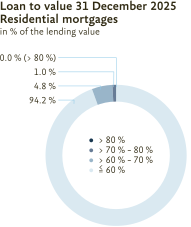
Mortgage-backed loans
There are binding rules for determining the market values (lending basis) of properties. The valuations are based on the respective use of the property (e.g. owner-occupied homes: hedonic model; investment properties: income capitalisation method). The lending basis for all valuations is the lower of cost or market value. The loans are to be amortised based on the type of property, loan-to-value ratio and purpose of use.
Other collateral
In particular, securities (such as shares, bonds or funds), financial investments and precious metals are accepted as collateral to cover Lombard loans and other secured loans. Depending on liquidity and tradability, LUKB applies haircuts to market or nominal values to cover the market risk associated with the collateral.
Use of derivative financial instruments
Derivative financial instruments are used in both the trading and banking books (in the banking book for hedging purposes as part of asset & liability management and equity securities in financial investments). Transactions are also carried out for the account of clients. Derivative financial instruments are traded only by the two organisational units Trading & Treasury Services and Structured Products Trading. Proprietary and client trading (including on a commission basis) takes place with standardised exchange-traded and OTC instruments on interest rates, currencies, equity securities/indices, precious metals and commodities. Derivative financial instruments can also be used as parts of structured products (e.g. dual currency investments and discount certificates). Structured products within the meaning of Art. 18 para. 1 FINMA AO consist of an underlying instrument and an embedded derivative. In the case of self-issued structured products, the derivative is separated from the underlying instrument and valued and accounted for separately, provided that:
- there is no close connection between the economic characteristics and risks of the embedded derivative and the underlying instrument,
- the structured product as a whole does not meet the terms and conditions for recognition as a trading transaction or the fair value option is not selected, and
- the embedded derivative as a stand-alone instrument meets the definition of a derivative financial instrument.
The bonds (underlying instrument) are recognised at nominal value under ‘Bond issues and central mortgage institution loans’. The derivative component is recognised at fair value in the balance sheet item ‘Positive replacement values of derivative financial instruments’ or ‘Negative replacement values of derivative financial instruments‘.
Income from self-issued structured products is recognised under ‘Result from trading activities and the fair value option’.
Hedge accounting
Hedge accounting is used to hedge interest-rate risk positions in the banking book as part of asset & liability management and against fluctuations in the value of equity securities in financial investments.
Hedging interest-rate risks in the banking book
Derivative financial instruments are used to manage the impact of future interest rate changes. Interest rate risks of interest rate-sensitive positions in the banking book are hedged by interest rate swaps and interest rate futures.
The hedging relationship as well as the objectives and strategy for hedging instruments are documented when the transaction is concluded, while the effectiveness of the hedging is periodically reviewed. For this purpose, assets and liabilities are considered separately. Hedging is classified as ‘effective’ if the present value of the derivative financial instruments changes in the opposite direction to that of the hedged group of underlying transactions. If this is not the case, the hedges are classified as ineffective and the excess portion of the derivative instrument is recognised under ‘Result from trading activities and the fair value option’.
Interest rate swaps are concluded between the trading book and the banking book to hedge interest rate risks. The treatment of these is described in Section ‘Detailed provisions‘ under ‘Positive and negative replacement values of derivative financial instruments‘.
Hedging of fluctuations in the value of equity securities in financial investments
Futures sold or put options purchased on the SMI, SLI or DAX indices on the stock exchange qualify as hedging instruments for equity securities denominated in Swiss francs or euros in financial investments. The ratio of the contract value of the hedging instruments (delta-weighted for options) to the market values of the hedged equities (adjusted by the ratio of book to market values calculated at the time of the hedging trigger as well as by the beta) must be between 50 % and 150 % during the tenor of the hedge. If the ratio moves outside this range, the hedging transaction is considered ineffective and is reclassified as a trading transaction.
Situation on the balance sheet date
As in the previous year, no hedging transactions had to be classified as ineffective on the balance sheet date.
No extraordinary events that have a material effect on the assets, financial position or results of operations of Luzerner Kantonalbank AG occurred after the balance sheet date.
Amounts in 1,000 Swiss francs | 31.12.2025 | 31.12.2024 | Change | |||
Book value of receivables from cash collateral delivered in connection with securities borrowing and reverse repurchase transactions1) | 0 | 0 | 0 | |||
Book value of obligations from cash collateral delivered in connection with securities lending and repurchase transactions1) | 2,571,911 | 3,861,798 | – 1,289,887 | |||
Book value of securities lent in connection with securities lending or delivered as collateral in connection with securities borrowing as well as securities in own portfolio transferred in connection with repurchase agreements | 2,617,412 | 3,957,324 | – 1,339,911 | |||
of which, with unrestricted right to resell or pledge | 2,617,412 | 3,957,324 | – 1,339,911 | |||
Fair value of securities received and serving as collateral in connection with securities lending or securities borrowed in connection with securities borrowing as well as securities received in connection with reverse repurchase agreements with an unrestricted right to resell or pledge | 61,175 | 92,968 | – 31,793 | |||
of which, repledged securities | 0 | 0 | 0 | |||
of which, resold securities | 55,948 | 88,166 | – 32,219 |
1)Before taking into account any netting agreements
Collateral for loans/receivables and off-balance-sheet transactions
Amounts in 1,000 Swiss francs | Mortgage collateral | Other collateral | Unsecured | Total | ||||
Loans (before netting with value adjustments) | ||||||||
Amounts due from clients | 490,263 | 2,263,058 | 2,804,781 | 5,558,102 | ||||
Mortgage loans | 40,996,311 | 0 | 6 4171) | 41,002,729 | ||||
| 33,873,269 | 0 | 4,436 | 33,877,705 | ||||
| 4,925,931 | 0 | 1,000 | 4,926,931 | ||||
| 892,852 | 0 | 467 | 893,319 | ||||
| 1,304,259 | 0 | 515 | 1,304,774 | ||||
Total loans (before netting with value adjustments) | 41,486,574 | 2,263,058 | 2,811,198 | 46,560,831 | ||||
Share as % | 89.1 | 4.9 | 6.0 | 100.0 | ||||
Previous year | 38,924,324 | 1,978,860 | 2,657,617 | 43,560,801 | ||||
Share as % | 89.4 | 4.5 | 6.1 | 100.0 | ||||
Value adjustments | 0 | 0 | 208,203 | 208,203 | ||||
Total loans (after netting with value adjustments) | 41,486,574 | 2,263,058 | 2,602,995 | 46,352,628 | ||||
Share as % | 89.5 | 4.9 | 5.6 | 100.0 | ||||
Previous year | 38,924,324 | 1,978,860 | 2,470,832 | 43,374,016 | ||||
Share as % | 89.7 | 4.6 | 5.7 | 100.0 | ||||
Off-balance-sheet transactions | ||||||||
Contingent liabilities | 39,769 | 111,725 | 147,454 | 298,948 | ||||
Irrevocable commitments | 526,656 | 310,404 | 1,558,972 | 2,396,031 | ||||
Obligations to pay up shares and make further contributions | 0 | 0 | 101,691 | 101,691 | ||||
Credit commitments | 0 | 0 | 0 | 0 | ||||
Total off-balance-sheet transactions | 566,424 | 422,129 | 1,808,117 | 2,796,670 | ||||
Previous year | 476,733 | 429,317 | 1,522,850 | 2,428,901 |
1)These are value-adjusted items.
Impaired loans
Amounts in 1,000 Swiss francs | Gross debt amount | Estimated liquidation value of collateral | Net debt amount | Individual value adjustments | ||||
Impaired loans | 232,555 | 73,838 | 158,717 | 119,275 | ||||
Previous year | 192,797 | 75,720 | 117,077 | 103,537 |
Individual value adjustments do not fully cover the net amount owed if a portion of it is considered to still be recoverable.
Non-performing loans
Amounts in 1,000 Swiss francs | 31.12.2025 | 31.12.2024 | Change | |||
Loans to customers | 79,684 | 55,585 | 24,099 | |||
Total non-performing receivables | 79,684 | 55,585 | 24,099 |
For a definition of overdue receivables, see Section 4 ‘Methods used for identifying default risks and determining the need for value adjustments and provisions‘. In particular, a distinction must be made between impaired loans/receivables and overdue loans/receivables. If a receivable is overdue, this may be an indication of a risk. However, if the amount of the loan/receivable is satisfactorily covered, no value adjustment is necessary.
Book value | ||||||
Amounts in 1,000 Swiss francs | 31.12.2025 | 31.12.2024 | Change | |||
Assets | ||||||
Debt securities, money market securities / transactions | 308,625 | 326,089 | – 17,465 | |||
of which, listed | 303,920 | 316,262 | – 12,342 | |||
Equity securities | 1,266,542 | 1,096,569 | 169,974 | |||
Precious metals | 1,809 | 1,238 | 570 | |||
Cryptocurrencies | 0 | 0 | 0 | |||
Other trading portfolio assets | 115,944 | 65,302 | 50,642 | |||
Total trading portfolio assets | 1,692,920 | 1,489,198 | 203,722 | |||
Structured products | 0 | 0 | 0 | |||
Total other financial instruments at fair value | 0 | 0 | 0 | |||
Total assets | 1,692,920 | 1,489,198 | 203,722 | |||
of which, determined using a valuation model | 0 | 0 | 0 | |||
of which, securities eligible for repo transactions in accordance with liquidity requirements | 166,369 | 242,985 | – 76,616 | |||
Liabilities1) | ||||||
Debt securities, money market securities / transactions | 55,948 | 88,166 | – 32,218 | |||
of which, listed | 55,948 | 88,166 | – 32,219 | |||
Equity securities | 1 | 0 | 0 | |||
Precious metals and commodities | 0 | 0 | 0 | |||
Cryptocurrencies | 0 | 0 | 0 | |||
Other trading portfolio liabilities | 0 | 0 | 0 | |||
Total trading portfolio liabilities | 55,949 | 88,167 | – 32,218 | |||
Structured products | 927,691 | 695,172 | 232,519 | |||
Total liabilities from other financial instruments at fair value | 927,691 | 695,172 | 232,519 | |||
Total liabilities | 983,640 | 783,339 | 200,301 | |||
of which, determined using a valuation model | 927,691 | 695,172 | 232,519 | |||
1)For short positions (posting according to the closing date principle)
Breakdown by contract type
Trading instruments | Hedging instruments | |||||||||||
Amounts in 1,000 Swiss francs | Positive replacement values | Negative replacement values | Contract volume | Positive replacement values | Negative replacement values | Contract volume | ||||||
Interest rate instruments | 38,283 | 46,294 | 2,051,788 | 116,840 | 142,283 | 11,664,310 | ||||||
Forward contracts including FRAs | 0 | 0 | 0 | 0 | 0 | 0 | ||||||
Swaps | 38,283 | 46,294 | 2,030,803 | 116,840 | 142,283 | 11,664,310 | ||||||
Tom Next Indexed Swaps (TOIS) | 0 | 0 | 0 | 0 | 0 | 0 | ||||||
Caps / Floors / Collars | 0 | 0 | 0 | 0 | 0 | 0 | ||||||
Options (OTC) | 0 | 0 | 0 | 0 | 0 | 0 | ||||||
Options (exchange-traded) | 0 | 0 | 0 | 0 | 0 | 0 | ||||||
Futures | 0 | 0 | 20,985 | 0 | 0 | 0 | ||||||
Foreign exchange / precious metals | 37,774 | 31,614 | 8,611,132 | 0 | 0 | 0 | ||||||
Forward contracts | 36,238 | 30,831 | 8,397,563 | 0 | 0 | 0 | ||||||
Combined interest rate / currency swaps | 0 | 0 | 0 | 0 | 0 | 0 | ||||||
Futures | 0 | 0 | 0 | 0 | 0 | 0 | ||||||
Options (OTC) | 1,536 | 783 | 213,568 | 0 | 0 | 0 | ||||||
Options (exchange-traded) | 0 | 0 | 0 | 0 | 0 | 0 | ||||||
Equity securities / indices | 65,888 | 175,107 | 3,211,996 | 0 | 0 | 0 | ||||||
Forward contracts | 0 | 0 | 0 | 0 | 0 | 0 | ||||||
Swaps | 0 | 0 | 0 | 0 | 0 | 0 | ||||||
Futures | 0 | 0 | 2,082 | 0 | 0 | 0 | ||||||
Options (OTC) | 57,696 | 40,087 | 1,827,380 | 0 | 0 | 0 | ||||||
Options (exchange-traded) | 8,192 | 135,021 | 1,382,534 | 0 | 0 | 0 | ||||||
Credit derivatives | 114 | 1,174 | 36,894 | 0 | 0 | 0 | ||||||
Credit default swaps | 114 | 1,174 | 36,894 | 0 | 0 | 0 | ||||||
Total return swaps | 0 | 0 | 0 | 0 | 0 | 0 | ||||||
First-to-default swaps | 0 | 0 | 0 | 0 | 0 | 0 | ||||||
Other credit derivatives | 0 | 0 | 0 | 0 | 0 | 0 | ||||||
Other derivative financial instruments | 473 | 473 | 4,232 | 0 | 0 | 0 | ||||||
Forward contracts | 0 | 0 | 0 | 0 | 0 | 0 | ||||||
Swaps | 0 | 0 | 0 | 0 | 0 | 0 | ||||||
Futures | 0 | 0 | 0 | 0 | 0 | 0 | ||||||
Options (OTC) | 0 | 0 | 0 | 0 | 0 | 0 | ||||||
Options (exchange-traded) | 473 | 473 | 4,232 | 0 | 0 | 0 | ||||||
Total before netting agreements | 142,532 | 254,662 | 13,916,041 | 116,840 | 142,283 | 11,664,310 | ||||||
of which, determined using a valuation model | 133,867 | 119,168 | – | 116,840 | 142,283 | – | ||||||
Previous year | 274,104 | 293,896 | 13,652,134 | 142,436 | 187,050 | 10,663,453 | ||||||
of which, determined using a valuation model | 263,057 | 190,382 | – | 142,436 | 187,050 | – | ||||||
Positive replacement values | Negative replacement values | Contract volume | ||||||||||
Total after netting agreements | 89,613 | 176,627 | 25,580,351 | |||||||||
Previous year | 174,381 | 190,445 | 24,315,587 | |||||||||
FRA = Forward rate agreement
OTC = Over the counter
RV = Replacement values
Breakdown by counterparty
Amounts in 1,000 Swiss francs | Central clearing houses | Banks and securities firms | Other customers | |||
Positive replacement values (after netting agreements) | 271 | 7,787 | 81,555 | |||
Previous year | 0 | 54,489 | 119,891 |
Breakdown by contract type
Book value | Fair value | |||||||
Amounts in 1,000 Swiss francs | 31.12.2025 | 31.12.2024 | 31.12.2025 | 31.12.2024 | ||||
Debt securities | 4,886,181 | 4,749,301 | 4,909,396 | 4,782,163 | ||||
of which, intended to be held to maturity | 4,868,666 | 4,730,490 | 4,890,493 | 4,762,470 | ||||
of which, not intended to be held to maturity (available for sale) | 17,515 | 18,811 | 18,903 | 19,693 | ||||
Equity securities | 403,920 | 404,386 | 462,615 | 447,101 | ||||
of which, qualified participations1) | 0 | 0 | 0 | 0 | ||||
Money market securities | 0 | 0 | 0 | 0 | ||||
Precious metals | 0 | 0 | 0 | 0 | ||||
Real estate | 0 | 0 | 0 | 0 | ||||
Total financial investments | 5,290,101 | 5,153,687 | 5,372,011 | 5,229,265 | ||||
of which, securities eligible for repo transactions in accordance with liquidity requirements | 4,727,180 | 4,624,854 | – | – | ||||
1)At least 10% of the capital or votes
Breakdown of counterparties by rating
Amounts in 1,000 Swiss francs | Very good to good credit rating (AAA bis AA-) | Good to satisfactory credit rating (A+ bis A-) | Satisfactory credit rating (BBB+ bis BBB-) | Sufficient credit rating (BB+ bis BB-) | Deficient credit rating (B+ bis B-) | Insufficient credit rating (CCC+ bis CCC-) | Without rating | |||||||
Book values of debt securities1) | 4,550,959 | 270,523 | 42,067 | 0 | 0 | 750 | 21,882 | |||||||
Previous year | 4,623,632 | 48,954 | 20,013 | 0 | 0 | 1,200 | 55,501 |
1)Incl. money market securities
The classification into the different rating classes was carried out using a model based on external ratings. The ratings classes corresponding to the ratings of Standard & Poor's are shown in brackets.
Overview of non-consolidated participations
Amounts in 1,000 Swiss francs | Cost value | Accumulated value adjustments / changes in book value (equity valuation) | Book value as of 31.12.2024 | Additions | Disposals | Value adjustments | Changes in book value for participations using the equity method / depreciation reversals | Book value as of 31.12.2025 | ||||||||
Participations without market value | 35,523 | – 6,478 | 29,045 | 481 | 0 | – 1,423 | 240 | 28,343 | ||||||||
of which, valued using the equity method | 2,069 | 1,791 | 3,860 | 0 | 0 | 0 | 240 | 4,100 | ||||||||
of which, other participations | 33,454 | – 8,269 | 25,185 | 481 | 0 | – 1,423 | 0 | 24,243 | ||||||||
Total non-consolidated participations | 35,523 | – 6,478 | 29,045 | 481 | 0 | – 1,423 | 240 | 28,343 |
Participations sold in the previous year are no longer included in the cost of acquisition and in the value adjustments accumulated to date.
Disclosures on significant participations
Share in % | ||||||||||
Company name | Domicile | Business activity | Share capital in 1,000 Swiss francs | Share capital 31.12.2025 | Voting rights 31.12.2025 | |||||
Fully consolidated participations | ||||||||||
LUKB Expert Fondsleitung AG | Lucerne | Fund management | 5,000 | 100.0 | 100.0 | |||||
Participations valued using the equity method | ||||||||||
RSN Risk Solution Network AG | Lucerne | Financial services | 4,500 | 33.3 | 33.3 | |||||
FG Next Holding AG | Zurich | Financial services | 373 | 26.8 | 26.8 | |||||
Participations in joint arrangements1) | ||||||||||
Pfandbriefzentrale der schweizerischen Kantonalbanken AG | Lucerne | Pfandbrief institution | 2 225 0002) | 4.3 | 4.3 | |||||
Viseca Payment Services AG | Zurich | Financial services | 25,000 | 2.7 | 2.7 | |||||
1)With an ownership stake ≥ 2 % and a capital interest of LUKB ≥ 0.5 million Swiss francs
2)Of which paid-in: 20% i.e. 445 million Swiss francs
The shareholding also corresponds to the share of voting rights, as none of the listed companies holds voting shares. All votes are held directly. In addition to the significant parand ownership interests in joint ventures listed above, there are also investments in local assets.
Amounts in 1,000 Swiss francs | Cost value | Accumulated depreciation | Book value as of 31.12.2024 | Reclassifications | Additions | Disposals | Depreciation | Reversals | Book value as of 31.12.2025 | |||||||||
Real estate | 405,345 | – 186,808 | 218,537 | 0 | 3,988 | 0 | – 8,762 | 0 | 213,763 | |||||||||
of which, bank buildings | 370,303 | – 184,101 | 186,202 | 31 | 3,935 | 0 | – 8,358 | 0 | 181,810 | |||||||||
of which, other real estate | 35,042 | – 2,707 | 32,335 | – 31 | 53 | 0 | – 404 | 0 | 31,953 | |||||||||
Other tangible fixed assets | 33,920 | – 33,920 | 0 | 0 | 20,164 | 0 | – 20,164 | 0 | 0 | |||||||||
Total tangible fixed assets | 439,265 | – 220,728 | 218,537 | 0 | 24,152 | 0 | – 28,926 | 0 | 213,763 | |||||||||
Liabilities: | ||||||||||||||||||
Leasing obligations not recognised in the balance sheet | ||||||||||||||||||
(Operating lease)1) |
1)There are lease agreements for business premises (branches) with remaining terms of more than one year, which the bank does not treat as operating leases.
Tangible fixed assets sold or liquidated in the previous year are no longer included in the acquisition value or the depreciation accumulated to date.
Amounts in 1,000 Swiss francs | 31.12.2025 | 31.12.2024 | ||
Other assets | ||||
Offset account | 1,495 | 43,667 | ||
Indirect taxes | 20,227 | 9,974 | ||
Settlement accounts | 2,850 | 1,808 | ||
Other assets | 2 | 0 | ||
Total other assets | 24,574 | 55,449 | ||
Other liabilities | ||||
Offset account | 0 | 0 | ||
Indirect taxes | 9,116 | 33,241 | ||
Settlement accounts | 4,978 | 15,896 | ||
Unredeemed coupons, cash bonds and bond issues | 3,130 | 3,126 | ||
Other liabilities | 0 | 2 | ||
Total other liabilities | 17,223 | 52,265 |
31.12.2025 | 31.12.2024 | |||||||
Amounts in 1,000 Swiss francs | Book value | Effective commitment | Book value | Effective commitment | ||||
Liquid assets1) | 69,097 | 69,097 | 68,992 | 68,992 | ||||
Amounts due from banks | 198,478 | 198,478 | 202,728 | 202,054 | ||||
Amounts due from clients | 505 | 505 | 29,872 | 31,539 | ||||
Own securities | 240,502 | 23,451 | 230,454 | 31,308 | ||||
Pledged or assigned mortgage loans to secure central mortgage institution loans | 11,190,068 | 8,525,000 | 11,271,419 | 7,821,000 | ||||
Total pledged / assigned assets | 11,698,651 | 8,816,531 | 11,803,465 | 8,154,894 | ||||
Total assets under reservation of ownership | 0 | 0 | 0 | 0 | ||||
1)Pledged or assigned liquid funds to secure the 50% payment obligation to esisuisse in connection with deposit insurance.
Securities serving as collateral for which the right to resell or pledge has been granted as part of the securities financing transaction are shown in Section 8.1 ‘Securities financing transactions (assets and liabilities)’.
Commitments relating to own pension funds
Amounts in 1,000 Swiss francs | 31.12.2025 | 31.12.2024 | Change | |||
Amounts due in respect of customer deposits | 18,363 | 22,722 | – 4,359 | |||
Total commitments relating to Pension Fund of Luzerner Kantonalbank | 18,363 | 22,722 | – 4,359 |
These liabilities arise from investments within the Group by Luzerner Kantonalbank's pension fund.
Own shares with own pension institutions
Numbers of shares | 31.12.2025 | 31.12.2024 | Change | |||
Pension Fund of Luzerner Kantonalbank | 0 | 0 | 0 |
Employer contribution reserves
Net amount | Effect of employer contribution reserves on personnel expenses | |||||||||||
Amounts in 1,000 Swiss francs | Nominal value | Waiver of use | 31.12.2025 | 31.12.2024 | 2025 | 2024 | ||||||
Pension funds | 0 | 0 | 0 | 0 | 0 | 0 | ||||||
Total employer contribution reserves | 0 | 0 | 0 | 0 | 0 | 0 | ||||||
Economic benefit/obligations and pension expenses
Over- / underfunding | Economic interest of the bank | Change in economic interest versus | Contributions paid | Pension expenses in personnel expenses | ||||||||||
Amounts in 1,000 Swiss francs | 31.12.2025 | 31.12.2025 | 31.12.2024 | previous year | 2025 | 2025 | 2024 | |||||||
Pension plans without overfunding / underfunding1) | 0 | 0 | 0 | 0 | 20,616 | 20,616 | 19,883 | |||||||
Total | 0 | 0 | 0 | 0 | 20,616 | 20,616 | 19,883 | |||||||
1)In the financial statements of the Pension Fund of Luzerner Kantonalbank prepared in accordance with Swiss GAAP FER 26, the coverage ratio as of 31 December 2025 amounts to 128.1 % (previous year 127.4 %). Accordingly, the fluctuation reserves – unlike in the previous year – have reached the target value of 25.6 %. Careful assessment has shown that, despite the free capital, there are no economic effects for the bank.
Book value | ||||||||||
Valued as a whole | Valued separately | |||||||||
Amounts in 1,000 Swiss francs Underlying risk of the embedded derivative | Booked in trading portfolio | Booked in other financial instruments at fair value | Value of the underlying instrument | Value of the derivative | Total | |||||
Interest rate instruments | ||||||||||
with own debenture component (oDC) | – | 0 | 0 | 0 | 0 | |||||
without oDC | 0 | 0 | 0 | 0 | 0 | |||||
Equity securities | ||||||||||
with own debenture component (oDC) | – | 927,691 | 1,164,123 | 49,656 | 2,141,470 | |||||
without oDC | 0 | 0 | 0 | 0 | 0 | |||||
Foreign currencies | ||||||||||
with own debenture component (oDC) | – | 0 | 29,848 | 117 | 29,965 | |||||
without oDC | 0 | 0 | 0 | 0 | 0 | |||||
Commodities / precious metals | ||||||||||
with own debenture component (oDC) | – | 0 | 104 | 0 | 104 | |||||
without oDC | 0 | 0 | 0 | 0 | 0 | |||||
Total issued structured products | 0 | 927,691 | 1,194,075 | 49,773 | 2,171,539 | |||||
Previous year | 0 | 695,172 | 1,022,212 | 71,825 | 1,789,209 | |||||
Overview of outstanding bonds and central mortgage institution loans
Amounts in million Swiss francs | Amount outstanding | Weighted average interest rate | Maturities | |||
Bond issues (Issuer: Luzerner Kantonalbank AG) | 8,334 | |||||
of which, non-subordinated | 6,774 | 1.015 % | 2027 bis 2071 | |||
of which, subordinated without PONV clause2) | – | – | – | |||
of which, subordinated with PONV clause2) | 1,560 | 1.583 % | 2031 bis unbefristet | |||
of which, subordinated Additional Tier 1 bonds | 960 | 2.208 % | unbefristet | |||
of which, subordinated Tier 2 bonds | 600 | 1.050 % | 2031 bis 2037 | |||
Central mortgage institution loans | 8,525 | 0.799 % | 2026 – 2046 | |||
Funding component of structured products3) | 1,194 | 0.340 % | 2026 – 2029 |
1)Maturities refers to the contractual maturity date of the individual bonds, whereas the bank may have contractual rights to early termination for individual bonds.
2)PONV clause = Point of no viability
3)Value of the underlying instruments according to the table «Issued structured products»
Maturity structure of outstanding bonds and central mortgage institution loans
Amounts in million Swiss francs | 2026 | 2027 | 2028 | 2029 | 2030 | after 2030 | Total | |||||||
Bonds | – | 475 | 450 | 100 | 475 | 6,834 | 8,334 | |||||||
Central mortgage institution loans | 442 | 647 | 1,012 | 780 | 909 | 4,735 | 8,525 | |||||||
Funding component of structured products1) | 924 | 238 | 31 | 0 | – | – | 1,194 | |||||||
Total | 1,366 | 1,360 | 1,493 | 880 | 1,384 | 11,569 | 18,053 |
1)Value of the underlying instruments according to the table «Issued structured products»
Amounts in 1,000 Swiss francs | Balance as of 31.12.2024 | Use in conformity with designated purpose | Reclassifications | Past due interest, recoveries | Additions charged to income statement | Reversals credited to income statement | Balance as of 31.12.2025 | |||||||
Provisions for pension obligations | 710 | – 106 | – | – | 0 | 0 | 604 | |||||||
Provisions for default risks1) | 16,649 | 0 | – 2,948 | 0 | 615 | – 805 | 13,511 | |||||||
of which, for probable liabilities (in accordance with Art. 28 para. 1 FINMA AO) | 16,649 | 0 | – 2,948 | 0 | 41 | – 805 | 12,937 | |||||||
Specific provisions for customer loans | 16,649 | 0 | – 2,948 | 0 | 12 | – 786 | 12,927 | |||||||
Lump-sum individual provisions | 0 | 0 | 0 | 0 | 29 | – 19 | 10 | |||||||
of which, for inherent risks of default | 0 | 0 | 0 | 0 | 574 | 0 | 574 | |||||||
provisions for inherent risks of default | 0 | 0 | 0 | 0 | 574 | 0 | 574 | |||||||
Provisions for restructuring | 2,119 | – 212 | – | 0 | 0 | 0 | 1,907 | |||||||
Other provisions | 10,886 | – 785 | 0 | 43 | 760 | – 82 | 10,822 | |||||||
Total provisions | 30,364 | – 1,103 | – 2,948 | 43 | 1,375 | – 887 | 26,844 | |||||||
Reserves for general banking risks2) | 694,354 | – | 0 | – | 0 | 0 | 694,354 | |||||||
Value adjustments for default and country risks | 194,224 | – 5,820 | 2,948 | 1,663 | 34,287 | – 16,773 | 210,530 | |||||||
of which, for default risks in respect of impaired loans / financial investments | 110,923 | – 5,820 | 2,948 | 1,663 | 28,639 | – 16,773 | 121,581 | |||||||
Specific value adjustment – banks | 0 | 0 | 0 | 0 | 0 | 0 | 0 | |||||||
Specific value adjustment – customer loans | 102,728 | – 1,803 | 2,948 | 1,280 | 27,894 | – 14,446 | 118,602 | |||||||
Specific value adjustment – interest | 631 | 0 | 0 | 384 | 0 | – 477 | 538 | |||||||
Lump-sum individual value adjustment | 177 | – 256 | 0 | 0 | 295 | – 82 | 135 | |||||||
Credit-related specific value adjustments – financial investments | 7,386 | – 3,761 | 0 | 0 | 450 | – 1,769 | 2,306 | |||||||
of which, for inherent risks of default | 83,301 | 0 | 0 | 0 | 5,648 | 0 | 88,949 | |||||||
Value adjustments for inherent risks of default | 83,301 | 0 | 0 | 0 | 5,648 | 0 | 88,949 |
1)For potential cash outflows related to off-balance sheet transactions
2)The reserves for general banking risks are subject to taxation.
31.12.2025 | 31.12.2024 | |||||||||||
Amounts in 1,000 Swiss francs | Total par value | Quantity | Dividend-bearing capital | Total par value | Quantity | Dividend-bearing capital | ||||||
Share capital, fully paid-in | 183,458 | 49,583,333 | 183,458 | 183,458 | 49,583,333 | 183,458 | ||||||
2025 | 2024 | |||||||
Equity securites | Equity securites | |||||||
Amounts in 1,000 Swiss francs | Number | Amount | Number | Amount | ||||
Members of the Board of Directors1) | n.a.2) | 465,500 | 8,448 | 407 6163) | ||||
Executive Board members | 19,354 | 1,222,786 | 26,534 | 1,191,642 | ||||
Employees | 188 2964) | 10,601,588 | 22,848 | 1,321,781 | ||||
Total | n.a. | 12,289,873 | 57,830 | 2,921,039 | ||||
1)The remunerations of the members of the Board of Directors relate to the periods AGM 2025 to AGM 2026 (14 April 2025 to 13 April 2026) and AGM 2024 to AGM 2025 (15 April 2024 to 14 April 2025).
2)The Board of Directors receives 50% of the proposed remuneration (total remuneration for the term AGM 2025 to AGM 2026: 931,000 Swiss francs) in shares blocked for at least six years (blocking period until 30 April 2032). 50% of the Board’s remuneration is paid in shares at the applicable tax value, with the number of shares rounded up to the nearest whole number. The relevant valuation for the equity rights recognised in the 2025 financial year is determined based on the volume-weighted average price for the period from 1 March 2026 to 13 April 2026. The exact number of allocated shares will be disclosed in the financial report 2026.
3)The shares allocated to the Board of Directors last year as part of the remuneration after the AGM 2025 were determined based on the volume-weighted average price for the period from 1 March 2025 to 14 April 2025, with the number of shares at the applicable tax value rounded up to the nearest whole number. The exact number was not yet known at the time of publication of the financial report 2024. Consequently, there are minor differences compared with the figures reported last year.
4)At periodic intervals, employees are offered the opportunity on a voluntary basis to acquire blocked registered shares of Luzerner Kantonalbank AG at preferential conditions. In 2025, 169,648 registered shares of Luzerner Kantonalbank AG with a price of 63.70 Swiss francs (average price for the month of december 2024) were purchased by employees at 45.00 Swiss francs. The discount of approximately 3.2 million Swiss francs is included in personnel expenses (partially accrued in previous years).
Members of the Board of Directors, the Executive Board and the second management level receive a defined portion of their compensation in the form of registered shares of Luzerner Kantonalbank AG that are blocked for several years. Details can be found in the Compensation Report.
Due from | Due to | |||||||
Amounts in 1,000 Swiss francs | 31.12.2025 | 31.12.2024 | 31.12.2025 | 31.12.2024 | ||||
Holders of qualified participations1) | 6,823 | 40,317 | 31,748 | 327 | ||||
Linked companies2) | 194,790 | 208,408 | 209,491 | 208,542 | ||||
Transactions with members of governing bodies | 13,135 | 11,327 | 14,377 | 13,578 | ||||
Other related parties3) | 26,350 | 25,156 | 2,844 | 2,751 | ||||
1)Canton of Lucerne
2)Public-law institutions of the Canton of Lucerne or mixed-economy enterprises in which the Canton of Lucerne holds a significant stake.
3)These are receivables and obligations towards legal entities closely related to the bank’s governing bodies.
Related parties include significant shareholders,the Executive Board, Board of Directors and auditors as well as associated companies and persons.
Transactions with related parties
Current and retired employees (including members of the Executive Board) and their family members living in the same household are eligible for generally-limited preferential conditions, as is customary in the industry. With the exception of the registered shares of Luzerner Kantonalbank AG deposited with LUKB without fees by the Canton, transactions are conducted for all related parties under the same terms that apply to third parties. Transactions include the granting of loans and credit, interest on deposits, account management, payments and securities transactions, etc.
Companies with close ties to members of the Board of Directors can participate in tenders for LUKB contracts. The member of the governing body concerned has no privileges when awarding the contract and is not represented in the decision-making process (abstention). During the reporting year and in the previous year, no contracts were awarded to related parties of members of the Board of Directors at terms other than what is customary in the market.
31.12.2025 | 31.12.2024 | |||||||
Amounts in 1,000 Swiss francs | Par value | Share as % | Par value | Share as % | ||||
Canton of Lucerne | 112,786 | 61.5 | 112,786 | 61.5 | ||||
Total significant shareholders | 112,786 | 61.5 | 112,786 | 61.5 | ||||
2025 | 2024 | |||||||
Own shares (registered) | Quantity | Average transaction price in Swiss francs | Quantity | Average transaction price in Swiss francs | ||||
Shares with nominal value 3.70 CHF | Shares with nominal value 3.70 CHF | |||||||
Number of shares as of 01.01. | 263,496 | – | 273,104 | – | ||||
+ Purchase of own shares | 36,627 | 69.41 | 64,780 | 68.35 | ||||
– Sale of own shares1), 2) | – 236,115 | 70.00 | – 74,388 | 70.16 | ||||
Number of shares as of 31.12.3) | 64,008 | – | 263,496 | – | ||||
1)Of which, 57,830 compulsory shares were associated with share-based compensation in 2025.
2)In 2025, a loss of 13,153 Swiss francs was generated on the trading portfolio and 1,365,316 Swiss francs on the rest of the portfolio (likewise included in the capital reserve). In 2024, a profit of 72,265 Swiss francs was generated on the trading portfolio and 52,382 Swiss francs on the rest of the portfolio (likewise included in the capital reserve).
3)On 31 December 2025, 27,062 own shares with a nominal value of 3.70 Swiss francs each (previous year: 30,595 own shares with a nominal value of 3.70 Swiss francs each) were held to hedge self-issued structured products (tracker certificates).
No options have been allocated for the 2024 and 2025 financial years, and there are no outstanding options.
Amounts in millions Swiss francs | At sight | Cancellable | Due within 3 Months | Due within 3 to 12 months | Due within 12 months to 5 years | Due after 5 years | No maturity | Total | ||||||||
Current assets | ||||||||||||||||
Liquid assets | 7,728.8 | 69.11) | – | – | – | – | – | 7,797.9 | ||||||||
Amounts due from banks | 475.5 | 0.0 | 78.1 | 70.0 | 35.0 | 0.0 | – | 658.6 | ||||||||
Amounts due from clients | 37.8 | 639.2 | 1,985.1 | 847.1 | 1,550.7 | 375.0 | – | 5,434.9 | ||||||||
Mortgage loans | 0.1 | 1,561.0 | 4,449.5 | 5,894.8 | 22,089.5 | 6,922.7 | 0.0 | 40,917.7 | ||||||||
Trading portfolio assets | 1,692.9 | 0.0 | – | – | – | – | – | 1,692.9 | ||||||||
Positive replacement values of derivative financial instruments | 89.6 | 0.0 | – | – | – | – | – | 89.6 | ||||||||
Financial investments | 421.4 | 0.0 | 45.2 | 253.0 | 2,136.3 | 2,434.2 | 0.0 | 5,290.1 | ||||||||
Total current assets | 10,446.2 | 2,269.3 | 6,557.9 | 7,064.9 | 25,811.5 | 9,731.9 | 0.0 | 61,881.7 | ||||||||
Previous year | 10,539.4 | 1,898.8 | 5,945.5 | 5,771.1 | 23,996.4 | 10,599.0 | 0.0 | 58,750.1 | ||||||||
Dept capital | ||||||||||||||||
Amounts due to banks | 242.5 | 9.4 | 3,967.0 | 1,447.4 | 40.0 | 0.0 | – | 5,706.2 | ||||||||
Amounts due to securities financing transactions | 0.0 | 0.0 | 2,571.9 | 0.0 | 0.0 | 0.0 | – | 2,571.9 | ||||||||
Amounts due in respect of customer deposits | 15,991.8 | 9,741.5 | 2,528.4 | 1,141.9 | 550.5 | 55.5 | – | 30,009.6 | ||||||||
Trading portfolio liabilities | 55.9 | 0.0 | – | – | – | – | – | 55.9 | ||||||||
Negative replacement values of derivative financial instruments | 176.6 | 0.0 | – | – | – | – | – | 176.6 | ||||||||
Liabilities from other financial instruments at fair value | 927.7 | 0.0 | – | – | – | – | – | 927.7 | ||||||||
Cash bonds | – | – | 18.8 | 68.4 | 107.0 | 12.0 | – | 206.2 | ||||||||
Bond issues and central mortgage institution loans | – | – | 197.6 | 1,168.9 | 5,112.4 | 11,574.1 | – | 18,053.0 | ||||||||
Total debt capital | 17,394.6 | 9,750.8 | 9,283.7 | 3,826.7 | 5,809.9 | 11,641.7 | – | 57,707.3 | ||||||||
Previous year | 14,150.0 | 10,155.9 | 10,917.5 | 4,032.6 | 4,408.5 | 11,074.7 | 0.0 | 54,739.2 |
1)Relates to securing half of the payment obligation to esisuisse in connection with the deposit protection scheme.
Amounts in 1,000 Swiss francs | 31.12.2025 | 31.12.2024 | ||||||
Rating1) | Amount | Share as % | Amount | Share as % | ||||
Switzerland | 59,891,296 | 96.21 | 57,047,027 | 96.44 | ||||
0 / «High Income» | 2,275,294 | 3.66 | 2,043,273 | 3.45 | ||||
1 | – | n.a. | – | n.a. | ||||
2 | 40,269 | 0.06 | 29,459 | 0.05 | ||||
3 | 22,816 | 0.04 | 21,654 | 0.04 | ||||
4 | 2,872 | 0.00 | 717 | 0.00 | ||||
5, 6 | 7,749 | 0.01 | 5,719 | 0.01 | ||||
7 | 184 | 0.00 | 98 | 0.00 | ||||
Not rated | 8,650 | 0.01 | 6,141 | 0.01 | ||||
Total foreign exposure | 2,357,834 | 3.79 | 2,107,061 | 3.56 | ||||
Not attributable to any country2) | 0 | 0.00 | 4 | 0.00 | ||||
Total assets | 62,249,130 | 100.00 | 59,154,092 | 100.00 | ||||
1)Ratings of SERV (Swiss Export Risk Insurance)
2)These are assets in cryptocurrencies.
SERV deems rating to be the OECD's classification of countries in the SC 0 to SC 7 and ‘high income’ categories. SC 0 stands for the lowest risk and SC 7 for the highest risk. The ‘high income’ category includes the high-income OECD countries and the high-income eurozone countries that are not classified by their risk.
Currencies, translated in CHF | ||||||||||
Amounts in millions Swiss francs | CHF | EUR | USD | Other | Total | |||||
Assets | ||||||||||
Liquid assets | 7,790.9 | 6.4 | 0.3 | 0.3 | 7,797.9 | |||||
Amounts due from banks | 167.5 | 85.0 | 201.5 | 204.6 | 658.6 | |||||
Amounts due from clients | 4,848.4 | 451.4 | 128.6 | 6.5 | 5,434.9 | |||||
Mortgage loans | 40,860.6 | 42.3 | 14.7 | 0.0 | 40,917.7 | |||||
Trading portfolio assets | 1,136.1 | 204.1 | 264.8 | 87.9 | 1,692.9 | |||||
Positive replacement values of derivative financial instruments | 79.5 | 5.0 | 4.9 | 0.2 | 89.6 | |||||
Financial investments | 4,792.2 | 349.5 | 127.5 | 20.8 | 5,290.1 | |||||
Accrued income and prepaid expenses | 95.6 | 2.9 | 2.0 | 0.2 | 100.7 | |||||
Non-consolidated participations | 28.3 | 0.0 | 0.0 | 0.0 | 28.3 | |||||
Tangible fixed assets | 213.8 | 0.0 | 0.0 | 0.0 | 213.8 | |||||
Other assets | 24.7 | – 0.3 | 0.1 | 0.1 | 24.6 | |||||
Total assets shown in balance sheet | 60,037.8 | 1,146.2 | 744.5 | 320.7 | 62,249.1 | |||||
Delivery entitlements from spot exchange, forward forex and forex options (contract values delta-weighted) | 2,111.3 | 2,563.2 | 3,403.8 | 358.0 | 8,436.2 | |||||
Total assets | 62,149.1 | 3,709.4 | 4,148.2 | 678.6 | 70,685.3 | |||||
Liabilities | ||||||||||
Amounts due to banks | 3,724.9 | 1,130.2 | 703.1 | 148.1 | 5,706.2 | |||||
Amounts due to securities financing transactions | 2,434.0 | 74.5 | 63.4 | 0.0 | 2,571.9 | |||||
Amounts due in respect of customer deposits | 27,846.8 | 1,421.5 | 501.1 | 240.2 | 30,009.6 | |||||
Trading portfolio liabilities | 55.9 | 0.0 | 0.0 | 0.0 | 55.9 | |||||
Negative replacement values of derivative financial instruments | 173.6 | 1.7 | 1.3 | 0.0 | 176.6 | |||||
Liabilities from other financial instruments at fair value | 618.6 | 182.1 | 127.0 | 0.0 | 927.7 | |||||
Cash bonds | 206.2 | 0.0 | 0.0 | 0.0 | 206.2 | |||||
Bond issues and central mortgage institution loans | 17,867.9 | 102.8 | 80.4 | 1.9 | 18,053.0 | |||||
Accrued expenses and deferred income | 260.5 | 5.7 | 6.6 | 0.3 | 273.2 | |||||
Other liabilities | 17.0 | 0.0 | 0.2 | 0.0 | 17.2 | |||||
Provisions | 26.6 | 0.3 | 0.0 | 0.0 | 26.8 | |||||
Reserves for general banking risks | 694.4 | 0.0 | 0.0 | 0.0 | 694.4 | |||||
Share capital | 183.5 | 0.0 | 0.0 | 0.0 | 183.5 | |||||
Capital reserve | 487.1 | 0.0 | 0.0 | 0.0 | 487.1 | |||||
Retained earnings | 2,568.8 | 0.0 | 0.0 | 0.0 | 2,568.8 | |||||
Own shares | – 4.5 | 0.0 | 0.0 | 0.0 | – 4.5 | |||||
Consolidated profit | 295.5 | 0.0 | 0.0 | 0.0 | 295.5 | |||||
Total liabilities shown in balance sheet | 57,456.6 | 2,918.9 | 1,483.1 | 390.5 | 62,249.1 | |||||
Delivery obligations from spot exchange, forward forex, forex options and precious metal transactions | 4,843.1 | 799.3 | 2,571.3 | 218.5 | 8,432.1 | |||||
Total liabilities | 62,299.7 | 3,718.1 | 4,054.5 | 608.9 | 70,681.3 | |||||
Net position per currency | – 150.7 | – 8.8 | 93.8 | n.a. | 4.1 | |||||
Previous year | – 56.1 | – 15.3 | 64.9 | n.a. | 55.7 | |||||
Amounts in 1,000 Swiss francs | 31.12.2025 | 31.12.2024 | Change | |||
Guarantees to secure credits and similar | 93,297 | 83,542 | 9,755 | |||
Performance guarantees and similar instruments | 190,648 | 191,340 | – 692 | |||
Irrevocable commitments arising from documentary letters of credit | 15,003 | 42,391 | – 27,388 | |||
Total contingent liabilities | 298,948 | 317,273 | – 18,325 |
Amounts in 1,000 Swiss francs | 31.12.2025 | 31.12.2024 | Change | |||
Commitments arising from deferred payments | 0 | 688 | – 688 | |||
Total loan commitments | 0 | 688 | – 688 |
Amounts in 1,000 Swiss francs | 31.12.2025 | As % of total | 31.12.2024 | As % of total | Change | |||||
Money market securities | 8,977.7 | 0.0 | 26,990.2 | 0.1 | – 18,012.5 | |||||
Medium-term notes | 206,243.0 | 0.6 | 283,012.0 | 0.9 | – 76,769.0 | |||||
Bonds | 3,126,035.1 | 8.9 | 3,080,661.6 | 10.2 | 45,373.5 | |||||
Shares (incl. participation certificates PC / profit-sharing certificates PSC) | 16,879,968.7 | 48.2 | 14,040,841.0 | 46.6 | 2,839,127.7 | |||||
Own investment funds | 6,389,323.8 | 18.2 | 5,594,507.5 | 18.6 | 794,816.3 | |||||
Third-party investment funds | 6,641,604.2 | 19.0 | 5,831,501.0 | 19.4 | 810,103.2 | |||||
Structured products | 634,434.1 | 1.8 | 526,184.8 | 1.7 | 108,249.4 | |||||
Cryptocurrencies | 50,830.9 | 0.1 | 37,091.3 | 0.1 | 13,739.6 | |||||
Other securities | 1,073,314.9 | 3.1 | 692,465.8 | 2.3 | 380,849.1 | |||||
Securities in custody | 35,010,732.4 | 100.0 | 30,113,255.2 | 100.0 | 4,897,477.2 | |||||
Global custody | 907,485.9 | 756,744.2 | 150,741.7 | |||||||
Managed securities | 35,918,218.3 | 30,869,999.4 | 5,048,218.9 | |||||||
Fiduciary investments with third-party-companies | 142,509.6 | 164,939.1 | – 22,429.5 | |||||||
Total securities and fiduciary assets | 36,060,728.0 | 31,034,938.6 | 5,025,789.4 |
PSC = Profit-sharing certificate
PC = Participation certificate
Interest and discount income
Amounts in 1,000 Swiss francs | 2025 | 2024 | Change | |||
Interest income due from banks | 6,066 | 4,977 | 1,089 | |||
Interest income from loans to customers | 614,496 | 718,742 | – 104,246 | |||
Other interest income | 13,471 | 111,072 | – 97,601 | |||
Credit commissions | 5,463 | 6,024 | – 561 | |||
Refinancing income from trading positions | 1,708 | 4,097 | – 2,388 | |||
Result from interest-rate hedging and other derivative transactions | 80,465 | 116,820 | – 36,354 | |||
Negative interest on lending business | – 14 | 0 | – 14 | |||
Total interest and discount income | 721,655 | 961,731 | – 240,075 |
Interest and dividend income from financial investments
Amounts in 1,000 Swiss francs | 2025 | 2024 | Change | |||
Interest income from financial investments | 39,571 | 34,983 | 4,589 | |||
Dividend income from financial investments | 13,165 | 11,390 | 1,775 | |||
Total interest and dividend income from financial investments | 52,736 | 46,372 | 6,364 |
Interest expense
Amounts in 1,000 Swiss francs | 2025 | 2024 | Change | |||
Interest expense due to banks | 75,953 | 176,002 | – 100,049 | |||
Interest expense due in respect of customer deposits | 66,959 | 201,661 | – 134,702 | |||
Interest expense due in cash bonds | 2,464 | 3,181 | – 717 | |||
Interest expense from bond issues and central mortgage institution loans1) | 152,982 | 156,539 | – 3,557 | |||
Other interest expense | 1,169 | 11,620 | – 10,450 | |||
Negative interest on deposit-taking business | – 747 | 0 | – 747 | |||
Total interest expense | 298,780 | 549,002 | – 250,222 |
1)The interest expense from structured products recognised under 'Bond issues and central mortgage institution loans' is reported in the line 'Interest expense from bond issues and central mortgage institution loans'.
Changes in value adjustments for default risk and losses from interest operations
Amounts in 1,000 Swiss francs | 2025 | 2024 | Change | |||
Specific value adjustment on customer loans | 12,971 | 9,083 | 3,889 | |||
Specific value adjustment on banks | 0 | 0 | 0 | |||
Lump-sum specific value adjustment | 213 | 304 | – 91 | |||
Credit-related specific value adjustment to financial investments | – 1,319 | 2,469 | – 3,788 | |||
Losses | 0 | 24 | – 24 | |||
Total for default risks on impaired loans / financial investments | 11,866 | 11,880 | – 14 | |||
Value adjustments for inherent default risks | 5,648 | 3,245 | 2,403 | |||
Total for inherent default risks | 5,648 | 3,245 | 2,403 | |||
Total changes in value adjustments for default risk and losses from interest operations | 17,514 | 15,125 | 2,389 |
Amounts in 1,000 Swiss francs | 2025 | 2024 | Change | |||
Fund business | 41,619 | 37,813 | 3,806 | |||
Asset management | 23,350 | 19,301 | 4,049 | |||
Investment advisory | 27,957 | 24,829 | 3,128 | |||
Adminsitration fee / custodian fee | 15,349 | 15,140 | 210 | |||
Brokerage fees | 13,282 | 10,992 | 2,290 | |||
Trust accounts | 166 | 220 | – 53 | |||
Other securities and investment business | 2,770 | 2,926 | – 156 | |||
Commission income from securities trading and investment activities | 124,494 | 111,221 | 13,273 | |||
Commission income from lending activities | 4,086 | 3,704 | 382 | |||
Card revenues | 15,225 | 14,736 | 490 | |||
Account management fees | 9,337 | 9,401 | – 65 | |||
Safe deposit box rentals | 1,197 | 1,157 | 41 | |||
Other service business | 3,348 | 3,124 | 224 | |||
Commission income from other services | 29,107 | 28,418 | 689 | |||
Commission expense | – 14,464 | – 13,231 | – 1,233 | |||
Total result from commission business and services | 143,223 | 130,111 | 13,112 |
Result from trading activities, by sector
Amounts in 1,000 Swiss francs | 2025 | 2024 | Change | |||
Client trading | 27,811 | 26,015 | 1,796 | |||
Proprietary trading | 48,165 | 30,488 | 17,677 | |||
Total result from trading activities and the fair value option | 75,976 | 56,503 | 19,473 |
Result from trading activities, by risk
Amounts in 1,000 Swiss francs | 2025 | 2024 | Change | |||
Foreign currencies / precious metals / cryptocurrencies | 40,302 | 36,215 | 4,088 | |||
Equity securities (incl. funds) | 27,453 | 27,679 | – 226 | |||
Fixed income instruments (including funds) | 9,929 | – 3,294 | 13,223 | |||
Refinancing income | – 1,708 | – 4,097 | 2,388 | |||
Total result from trading activities and the fair value option | 75,976 | 56,503 | 19,473 |
Hedging transactions for self-issued structured products that are measured using the fair value option and entered under ‘Liabilities from other financial instruments at fair value’ are recognised at fair value on the assets side of the trading business. The corresponding result is included in the total ‘Result from trading activities and the fair value option’. Separate recognition of income from applying the fair value option only to liabilities is not meaningful, which is why it is not used.
Amounts in 1,000 Swiss francs | 2025 | 2024 | Change | |||
Salaries and benefits | 176,115 | 167,867 | 8,248 | |||
of which: expenses related to share-based compensation | 5,016 | 4,694 | 322 | |||
Social security contributions (OASI/IV/UI, etc.) | 11,509 | 11,104 | 405 | |||
Pension expenses | 20,619 | 19,885 | 735 | |||
Training and continuing education | 2,179 | 2,100 | 79 | |||
Other personnel expenses | 7,983 | 8,036 | – 53 | |||
Total personnel expenses | 218,405 | 208,991 | 9,414 |
Amounts in 1,000 Swiss francs | 2025 | 2024 | Change | |||
Office space expenses | 6,504 | 5,868 | 636 | |||
Expenses for information and communications technology | 49,531 | 46,535 | 2,996 | |||
Expenses for vehicles, equipment, furniture and other fixtures, as well as operating lease expenses | 883 | 971 | – 87 | |||
Fees of audit firms | 769 | 749 | 20 | |||
of which, for financial and regulatory audits | 706 | 625 | 81 | |||
of which, for other services | 62 | 124 | – 62 | |||
Other operating expenses | 39,083 | 32,647 | 6,436 | |||
Total general and administrative expenses | 96,771 | 86,770 | 10,001 |
Amounts in 1,000 Swiss francs | 2025 | 2024 | Change | |||
Value adjustments on participations | 1,423 | 720 | 703 | |||
Depreciation on bank buildings | 8,358 | 8,435 | – 77 | |||
Depreciation on other real estate | 404 | 396 | 8 | |||
Depreciation on other tangible fixed assets | 20,164 | 19,363 | 801 | |||
Total value adjustments on participations and depreciation and amortisation of tangible fixed assets and intangible assets | 30,349 | 28,913 | 1,436 |
Amounts in 1,000 Swiss francs | 2025 | 2024 | Change | |||
Provisions for default risks | – 189 | – 3,345 | 3,156 | |||
of which for probable obligations (in accordance with Art. 28 para. 1 FINMA AO) | – 763 | – 3,345 | 2,582 | |||
of which provisions for inherent default risks | 574 | 0 | 574 | |||
Provisions for other risks | 678 | 634 | 44 | |||
Total changes to provisions and other value adjustments and losses | 488 | – 2,711 | 3,199 |
Amounts in 1,000 Swiss francs | 2025 | 2024 | Change | |||
Income from sale of participations | 212 | 31,580 | – 31,368 | |||
Total extraordinary income | 212 | 31,580 | – 31,368 |
Amounts in 1,000 Swiss francs | 2025 | 2024 | Change | |||
Losses from disposal of participations | 0 | 0 | 0 | |||
Total extraordinary expenses | 0 | 0 | 0 |
Amounts in 1,000 Swiss francs | 2025 | 2024 | Change | |||
Changes in reserves for general banking risks | 0 | 25,000 | – 25,000 | |||
Total changes in reserves for general banking risks | 0 | 25,000 | – 25,000 |
Amounts in 1,000 Swiss francs | 2025 | 2024 | Change | |||
Current income taxes | 35,127 | 30,860 | 4,268 | |||
Current capital taxes1) | 3,364 | 6,852 | – 3,488 | |||
Total current taxes | 38,491 | 37,711 | 780 | |||
Deferred taxes | 0 | 0 | 0 | |||
Total expenses for taxes | 38,491 | 37,711 | 780 | |||
Provisions for deferred taxes | 0 | 0 | 0 | |||
Weighted average tax rate (based on operating profit) | 11.5 % | 11.9 % | – 0.3 % |
1)Due to the reduction of the ordinary capital tax rate in the Canton of Lucerne from 0.5 per mille to 0.25 per mille starting from tax year 2025, the respective tax expense decreased accordingly.
Deferred tax assets and liabilities are netted for each taxable entity. The predominant deferred tax assets of a tax entity are only capitalised if their realisation can be foreseen. However, predominantly deferred tax liabilities are always reported.
Registered shares | ||||
Amounts in 1,000 Swiss francs | 31.12.2025 | 31.12.2024 | ||
Consolidated profit | 295,497 | 286,642 | ||
Net profit after taxes | 295,497 | 311,642 | ||
Outstanding participation rights | ||||
Average time-weighted number of shares | 49,474,029 | 49,330,079 | ||
Earnings per share | ||||
Consolidated profit undiluted / diluted | 5.97 | 5.81 | ||
Net profit after taxes undiluted / diluted | 5.97 | 6.32 | ||
At LUKB, fair and progressive working conditions form the basis for successful employment relationships. This includes ensuring that everyone is paid equally for doing the same work.
LUKB has participated voluntarily in the equal pay dialogue among Switzerland's social partners and the federal government since 2014 and was the first Swiss bank to successfully complete this process. LUKB meets its obligation to conduct an equal pay analysis, which came into effect on 1 July 2020, with a comprehensive analysis for the period from 1 July 2020 to 30 June 2021. The analysis was audited by PricewaterhouseCoopers AG (PwC). In its audit report of 15 June 2022, PwC confirmed that the analysis met the regulatory requirements. As has been the case without fail since 2014, the outcome shows that the gender pay gap at LUKB falls within the tolerance of 5 % and thus ensures wage equality.
LUKB believes in the importance of this issue and was thus awarded the ‘We Pay Fair’ certificate from the Competence Centre for Diversity & Inclusion (CCDI) of the University of St. Gallen in July 2023.